The 10 most famous design armchairs, from the Egg to the Proust
Egg, Wassily, Womb, UP5, Proust — the armchairs that shaped a century of design, their story in three lines and their alternatives at every price.
2 MIN · 5 OBJECTS IDENTIFIEDThe armchair is the designer's self-portrait: an object large enough to say everything, small enough to risk everything. From the Bauhaus tube to the postmodern manifesto, ten seats that tell the story of an entire century.
1. Egg — Arne Jacobsen, Fritz Hansen, 1958

Sculpted in plaster in Jacobsen's garage for the SAS Royal Hotel: a shell that shields you from the lobby like an egg. The most expensive Danish armchair — and the most counterfeited. See the original and its alternatives →
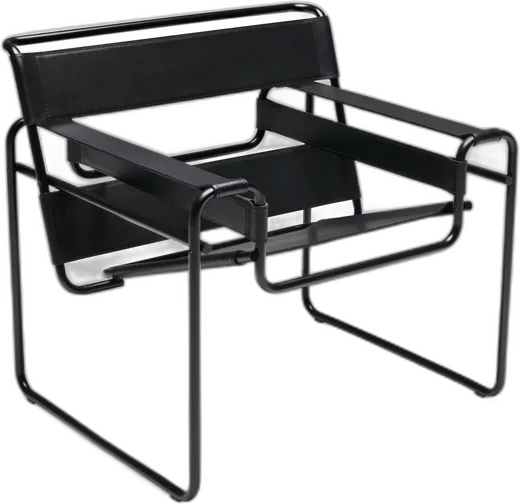
2. Wassily (B3) — Marcel Breuer, 1925

The first bent tubular-steel armchair in history, inspired by a bicycle handlebar. Kandinsky received an example — hence the name. The Bauhaus, seated. See the original and its alternatives →
3. Womb — Eero Saarinen, Knoll, 1948

Florence Knoll wanted “a chair like a basket of cushions to curl up in”. Saarinen answered with an enveloping fibreglass shell — the first armchair designed to be sat in sideways. See the original and its alternatives →
4. UP5&6 — Gaetano Pesce, B&B Italia, 1969

A mother-goddess body chained to its footstool: the most explicit feminist manifesto in design. Originally sold vacuum-compressed — it inflated as it came out of the box. See the original and its alternatives →
5. Proust — Alessandro Mendini, 1978

A fake Louis XV armchair hand-painted with pointillist dabs borrowed from Signac. The monument of postmodernism: everything about it is false, so everything is said. See the original and its alternatives →
6. Ball Chair — Eero Aarnio, 1963

A fibreglass sphere on a swivel: “a room within the room”, soundproofed and rotating. The space age fits inside this chair — cinema has never tired of it. See the original and its alternatives →
7. Elda — Joe Colombo, 1963

A swivelling fibreglass shell, rolled cushions, a wife's name. The first great Italian plastic armchair — and the favourite seat of cinema's villains. See the original and its alternatives →
8. Papa Bear — Hans Wegner, 1951

Wooden “bear paws” jutting from the armrests, a back made for sitting sideways. Danish craftsmanship at its peak — reckon on months of workshop time for a reissue. See the original and its alternatives →
9. Diamond — Harry Bertoia, Knoll, 1952

“Made of air, like a sculpture”: a sheet of steel wire folded into a diamond. Bertoia went on to live off his royalties, devoted to his sound sculptures. See the original and its alternatives →
10. Acapulco — anonymous, Mexico, 1950s

No designer, no patent: PVC cords stretched over a steel egg, born on Mexico's Pacific coast. Proof that an icon can belong to no one. See the original and its alternatives →
And if you've spotted one in a photo?
Every piece on this list has its own reference page on Beyit, with the original, its history and alternatives at every price. And if a piece of furniture intrigues you in a photo — an Instagram interior, a film, a period house — scan it: Beyit identifies it.
One photo, every piece identified.
Your room, a shop window, an inspiration screenshot: send the photo, we find the pieces and their alternatives at every price.
On iPhone, the app does the same from your camera.
The pieces, at your budget.
Every piece mentioned, with its alternatives — from vintage to dupe.