The Cy Twombly palette at Gaeta
Rust. Painter's grey. Sun-baked beige. Cement.
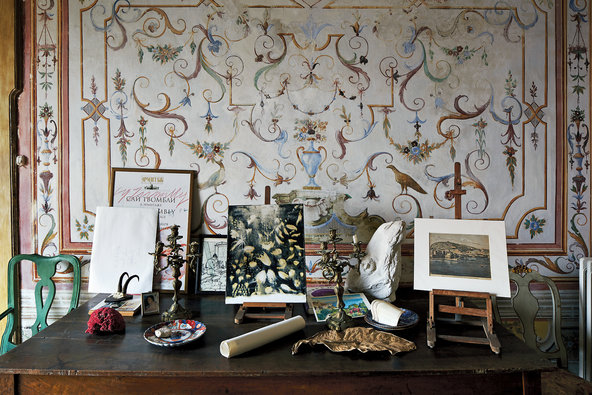
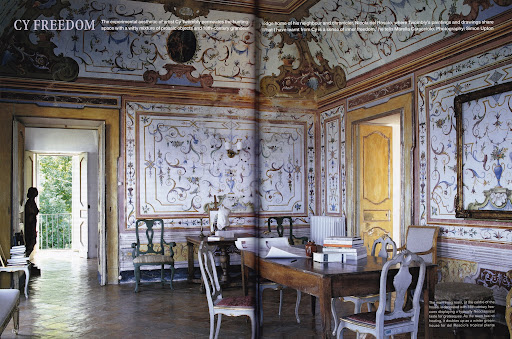
5 MIN · 5 OBJECTS IDENTIFIEDCy Twombly settled in Gaeta, on the Tyrrhenian coast between Rome and Naples, in 1988 — he was sixty, had just abruptly left his Roman studio on Piazza del Biscione, and was looking for a light more maritime and less urban. He would spend the bulk of his remaining twenty-three years there. The house he bought — a faded seventeenth-century palazzo, once owned by a family of sailors, with an inner courtyard open to the sea — has become, for generations of painters and decorators, an inexhaustible source of inspiration. The reason comes down to four colours, which he never theorised but which turn up everywhere, from walls to canvases, from skirting boards to planters forgotten outside. It is this palette we are trying here to name and to make actionable.
Rust
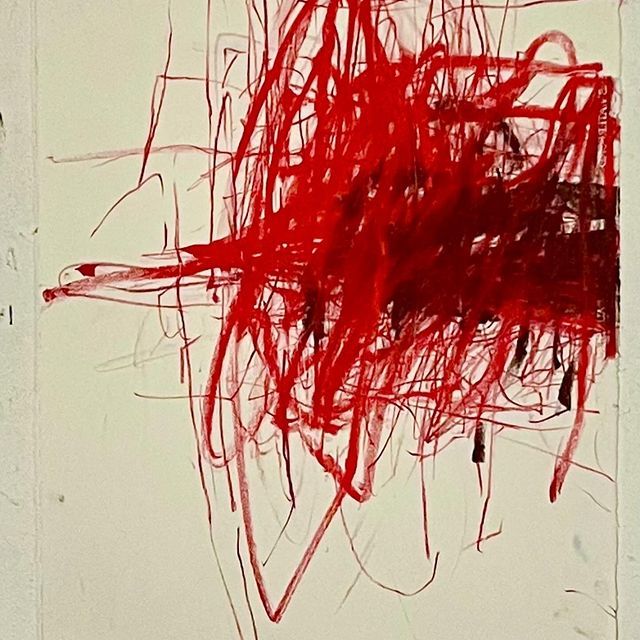
Not the rust of building sites, aggressive and orange, the kind that shouts. The muted rust of metal planters left forgotten in the inner courtyard, turned to a soft brown after twenty Tyrrhenian summers and three rains a year. It is a rust that holds diluted pink and beige, almost never pure orange. Twombly used it on the walls of the north studio, and exclusively on that one wall. Paired with yellow dominants (a kilim rug, a mustard linen cushion), it gives off a golden warmth. With grey (a pewter ceramic, a concrete lamp), it settles down and becomes almost architectural.
To reproduce at home: Farrow & Ball "Picture Gallery Red" applied diluted two to one with off-white, or Ressource "Terre de Sienne brûlée" with a patina wax applied three months later to age the pigment. On a single wall, never on four — rust needs contrast or it flattens the room. A more contemporary variant: Argile "Rouge Pompéien", which carries a hint of violet and holds particularly well on north-east walls.
Painter's grey
The grey of the ancient Greek pottery Twombly collected — he owned some thirty pieces, displayed on the shelves of the sitting room — the kind that turns towards sea-green in certain morning lights and towards mauve in others, late in the afternoon. It is the grey Twombly painted on the lower half of his walls, a sort of boiserie without the boiserie, up to about a metre ten in height — the height of a classical picture rail, which he dematerialised into pure paint.
To reproduce: Argile "Ciel de pluie", or Little Greene "Rolling Fog", or Farrow & Ball "Pavilion Gray" if you want a quieter version. To avoid at all costs: the bluish greys of the 2010 ranges (the likes of Farrow & Ball "Plummett"), far too cold — Twombly liked greys that hold warmth, that come alive by candlelight, that never quite turn hospitable.
Sun-baked beige
The stone of Gaeta, the porous limestone of Mount Orlando from which the town takes its name, an off-white that becomes pale ochre under midday sun and dusty pink at sunset. Twombly left the exterior walls bare, unpainted, washed with salt water once a year to remove the microscopic algae. Above all he let the light paint them — this was the part of his interior that required no work, and yet changed every hour.
To reproduce indoors: a lime-and-sand render in its natural shade, with no added pigment, applied in two thin coats with a wooden float to keep the texture. Reliable brands: Tassili, Tollens "Lumière", Ressource "Chaux Naturelle". Or, simpler and more accessible: Farrow & Ball "Joa's White", which mimics that stone that vibrates, or Argile "Coquillage", which adds an almost imperceptible pink note.
Cement
Not the industrial cement of car parks, but the cement-mortar poured on studio floors, which dries to a grey-beige with visible trowel marks, micro-bubbles, irregular shades from the curing. Twombly's studio floor was poured in 1989, and he worked there standing, barefoot part of the year, in felt slippers in winter. He liked its grain, its coolness in summer, and the way it absorbs drops of paint without staining the way a parquet does. The colour softens further with an antiquarian wax applied every three years.
To reproduce: a tinted polished concrete in beige-grey (Marius Aurenti, Mercadier), or, more economically, cement tiles from Carocim or Popham Design in a flat greige shade, avoiding patterns — the beauty of Twombly's floor lies in its unity. On the floor only — never carry it up onto the walls, that is the dividing line with the dated industrial lofts of the 2000s that pushed cement everywhere.
How the palette holds together
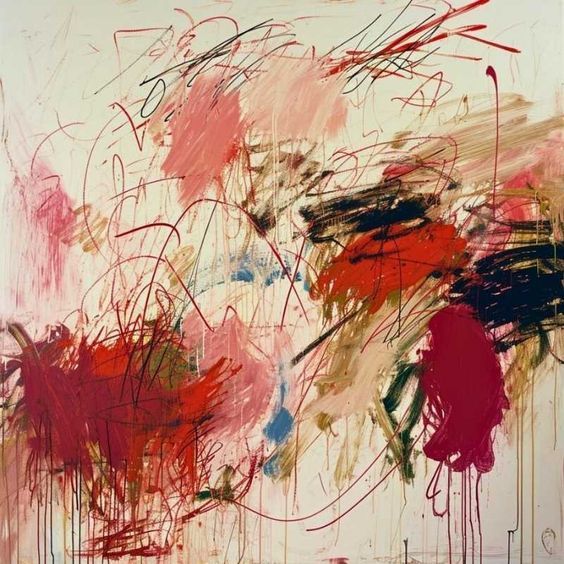
Four colours, four different temperatures: rust (warm saturated), painter's grey (cool neutral), sun-baked beige (warm luminous), cement (mineral neutral). None of them shouts, none of them disappears. Each occupies a distinct band of brightness on the greyscale (from lightest to darkest: sun-baked beige, cement, painter's grey, rust), which lets them speak to one another without ranking. The secret lies in that constant gap: no two colours ever share the same value, so there is never any conflict, never any uneasy vibration.
This is, in miniature, the principle of a Twombly interior: no focal point, no star piece of furniture, no signature colour — only a climate. And the climate holds because no colour is trying to win against the others. The whole art lies in the distribution, not in the choice: the same palette badly laid out (rust on the floor, cement on the walls) would be catastrophic. Twombly kept rust for a single wall, grey for the lower band of the inside walls, beige for all the natural light coming in, cement for the floor. It is that spatial hierarchy, not the swatch card itself, that makes the Gaeta palette.
A fifth colour, which has to be named
In truth, there is a fifth colour in Twombly's Gaeta palette — the one visitors always forget to mention because it is not painted: the deep green of the potted plants placed throughout the house, mostly dwarf olive trees and lemon trees in jars. That near-black green acts as a visual anchor in the composition, like a punctuation mark structuring a sentence. Without those dark greens the palette thins out and loses its frame. To reproduce it in Paris in 2026: a ficus lyrata, an olive tree in a terracotta pot, or simply two or three dense green plants gathered in one corner of the sitting room rather than scattered.
One photo, every piece identified.
Your room, a shop window, an inspiration screenshot: send the photo, we find the pieces and their alternatives at every price.
On iPhone, the app does the same from your camera.
The pieces, at your budget.
Every piece mentioned, with its alternatives — from vintage to dupe.


Gallery
5 images