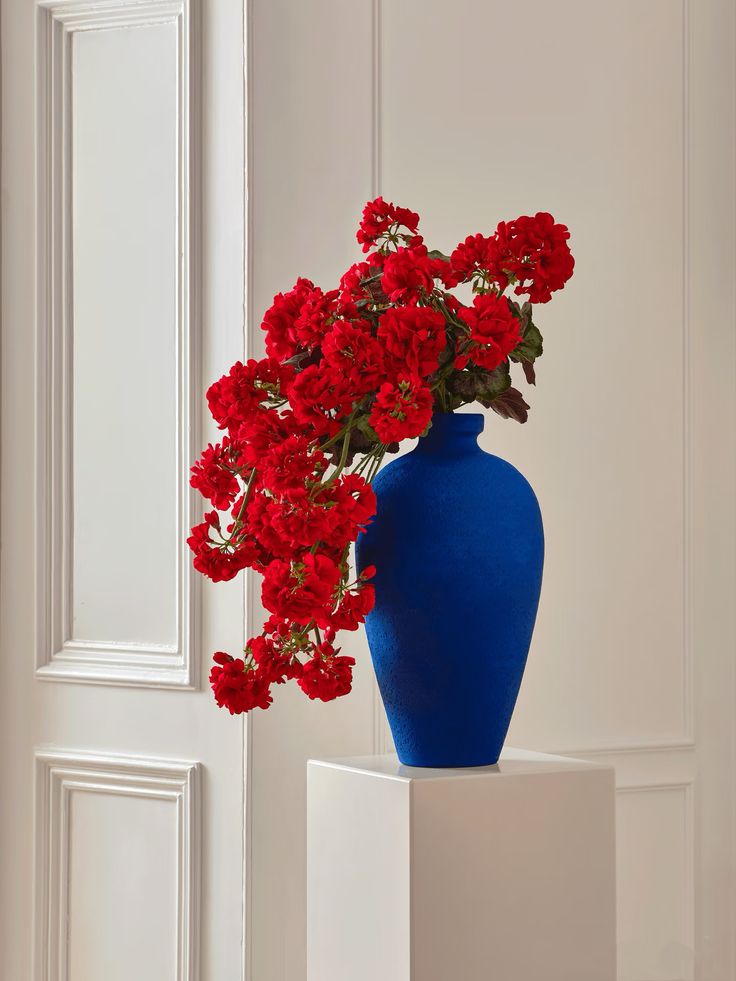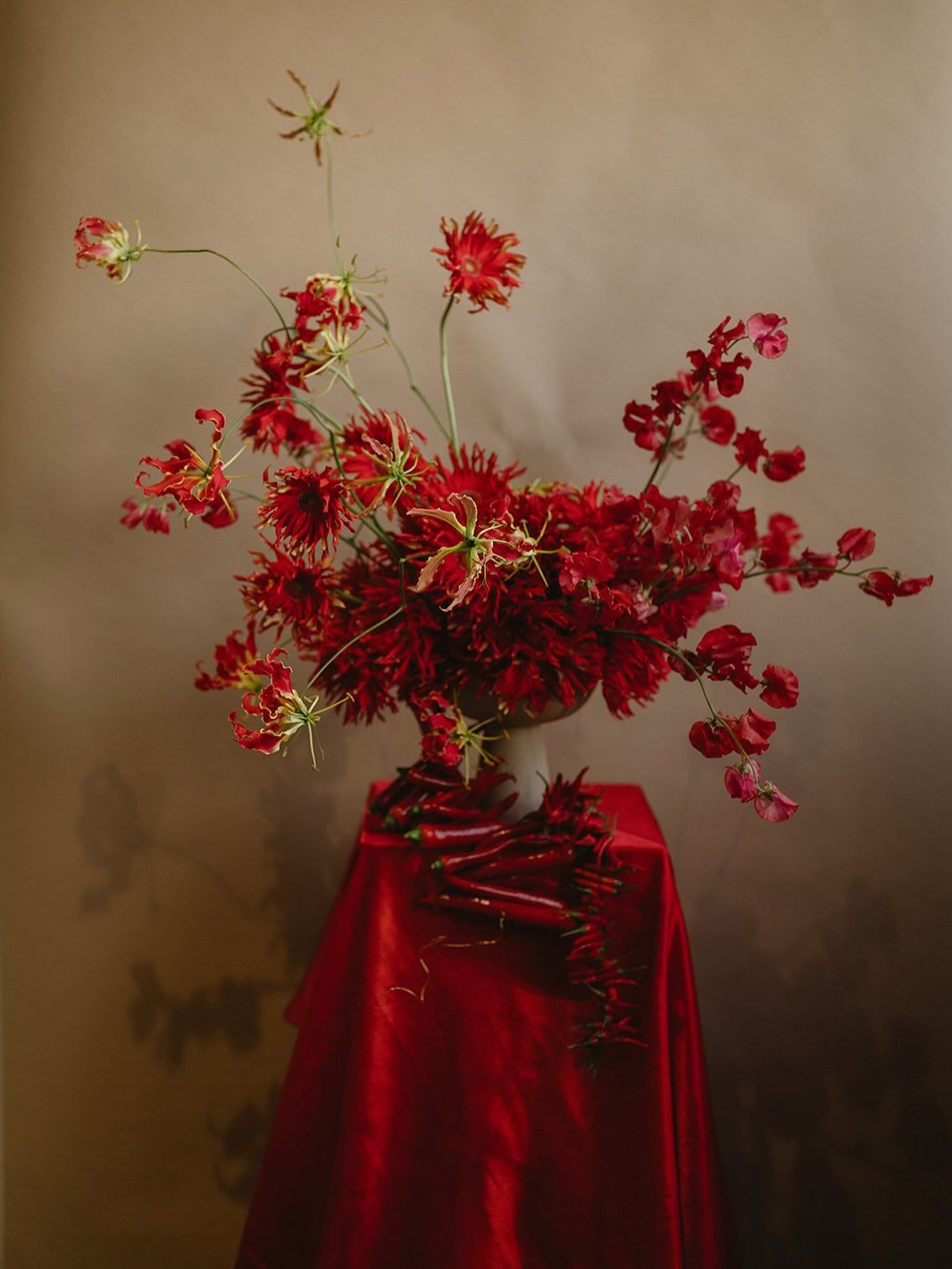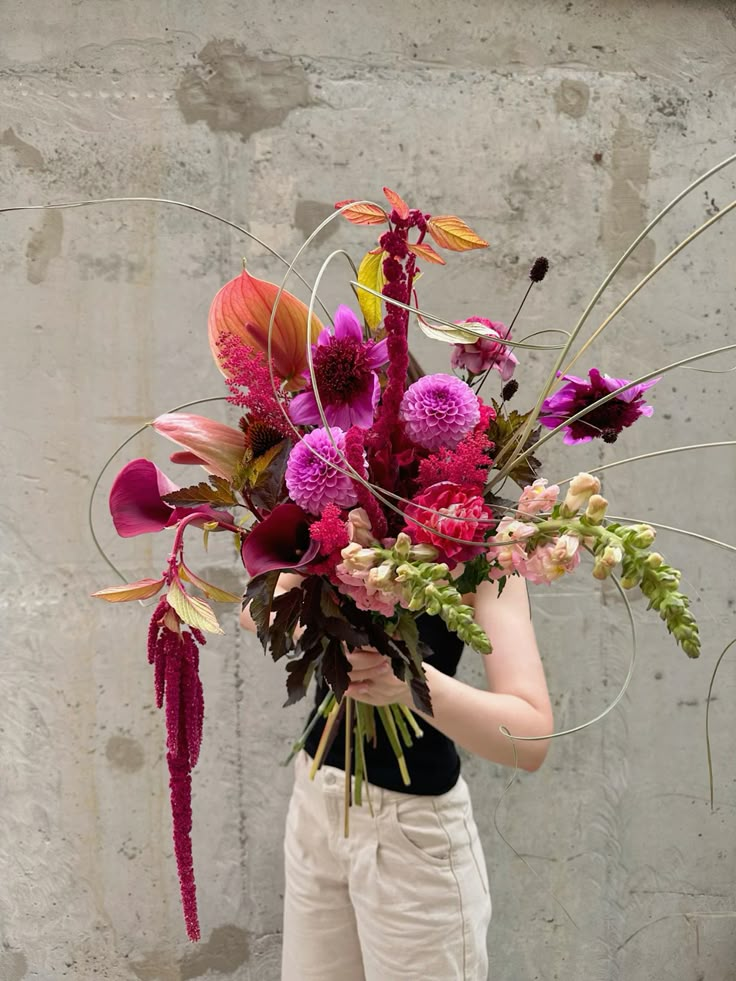
The artist's bouquet, Constance Spry's palette
Crimson roses, withered ivy, ruffled kale, faded mauve lilac. How the English florist of the 1930s still shapes the finest bouquets of 2026.
5 MIN · 5 OBJECTS IDENTIFIEDConstance Spry opened her London shop at 64 South Audley Street, Mayfair, in 1929 — the year of the crash, which hardly helped. And yet, within fifteen years, she had overturned the floral arts: gone the tight, dome-shaped posies of Victorian tea rooms, gone the obsession with the perfect long-stemmed rose, gone the florist's grammar inherited from the Edwardian age. Spry composed loose, asymmetrical arrangements, mixing noble flowers with humble matter — a withered ivy torn from a stone wall, a curly kale from the kitchen garden, a fruit-tree branch still patched with lichen. Her palette, still pertinent a century on, comes down to four colours we have tried to chart here, along with the substitutes that work in 2026 when the exact original cannot be found.
Deep crimson
The rose Tess of the d'Urbervilles, bred by David Austin in 2008 and named after Thomas Hardy's heroine, is the direct heir to the Spry palette. Deep burgundy, almost black at the heart, with a red-fruit scent that recalls blackberry jam, around eight to ten centimetres across at full bloom. To be used as a centrepiece, never massed — Spry always placed her crimson roses in groups of three, never more, out of a superstition inherited from her Welsh grandmother, who held that groups of five brought bad luck in a bouquet. The black rose Black Baccara, sometimes mistakenly thought of as an equivalent, is too uniform — it lacks the inner chromatic variation that keeps the Tess alive.
Season: June to September at specialist French florists (Debeaulieu, Eric Chauvin, Stéphane Chapelle), or year-round at Le Bon Marché Foliage (imported from Ecuador, lesser quality but always in stock). For vintage, original Spry vases can be found on Vinterior — they were made in matt green Wedgwood stoneware.
Withered green
Ivy torn from a stone wall — Spry insisted it be picked from a north-facing wall, where the leaves have already turned brown-green from winter damp. This is the signature Spry gesture, and the one that most scandalised the florist establishment of Mayfair in 1930: refusing fresh green and preferring the kind that is dying. It gives the bouquet a depth of matter, like patina on an old piece of furniture, and breaks what Spry called the tyranny of freshness. She believed that a bouquet too fresh looked commercial, young in the wrong sense, and that at least one decaying element had to be introduced to bring temporal depth.
Effective substitutes in 2026, in decreasing order of fidelity: the wild pittosporum found in Provençal markets in autumn, eucalyptus dried upside down for two weeks in a ventilated cupboard, royal-fern fronds dried on a radiator, and as a last resort olive leaves that have spent a summer on a Parisian balcony — less handsome but easy to find.
Faded mauve
Lilac, preferably white Syringa vulgaris turning mauve at the end of its flowering, picked two days after full bloom when the first petals begin to lose their turgor. Spry disliked overly blue flowers — she always sought the mauve that contains grey, never the one tending to periwinkle or summer sky. For 2026, with lilac available only in April and May and fragile once cut, three alternatives work: the peony Sarah Bernhardt at late maturity (when the heart has turned pink-mauve), dried hydrangeas (gathered in September and left on a dry shelf until use), or mauve scabious grown by the edible-flower market gardeners of the Île-de-France.
Cabbage green
Ruffled kale, cavolo nero in Italian. This was Spry's most radical addition, the one that pushed British floral art into modernity: to use a vegetable as floral matter, on the same footing as the rose. Curly kale, picked in autumn after the first frosts that concentrate its sugars and blue its leaves, gives a blue-green texture nothing else can imitate. Set low in the bouquet, it acts as a visual plinth and a chromatic anchor for the crimson flowers above. Spry also used it in her Christmas arrangements, where it served as a welcome replacement for predictable holly.
Alternatives in 2026: purple artichoke leaves dried upside down, romanesco broccoli left to bolt (with its spectacular fractal texture), the outer leaves of romanesco cabbage blanched overnight in salted water to fix the colour. To be avoided at all costs: raw red cabbage, whose colour bleeds into the other flowers within a few hours.
A fifth colour, not to be forgotten
Spry always used, as an almost imperceptible accent, a muted yellow note — miniature sunflowers, butter-yellow ranunculus, or dried California poppies. This yellow touch, around five per cent of the bouquet as a whole, serves to warm the overall palette, which would otherwise stay cold and be crushed by the crimson. It is a principle one finds in Venetian painting: the single yellow that rescues an otherwise overly sombre composition. Without this fifth colour, the Spry bouquet turns funereal.
How to compose a Spry bouquet in 2026
The rule of composition is easy to state, far harder to execute: total asymmetry (never mirror symmetry), varied heights across three distinct tiers (low/middle/high), a ratio of sixty per cent foliage and dead matter to forty per cent live flowers. Never a round bouquet in the manner of a traditional bridal posy — always a cascade, denser on one side than the other, with an asymmetrical point of equilibrium placed at about two-thirds of the height (close to the golden ratio). The vase must be opaque (low-fired terracotta, raw ceramic, matt-glazed stoneware, never clear glass, which shows the stems and kills the illusion of a wild garden).
And the signature Spry touch, found in every one of her documented arrangements: let a single flower stand fifteen centimetres above the rest — usually a Tess rose or a fleshy peony, on a long stem, placed as if by chance. Spry said that it is this flower that gives the rhythm to all the rest. It is the soloist, the focal point, what Japanese floral designers call the shu in ikebana — the guiding principle around which the whole composition is arranged.
Further reading
Two reference books for those who wish to dig deeper. Constance Spry's Flower Book, published in 1934 and regularly reprinted (the latest Phaidon edition of 2024 contains four hundred pages of duotone photographs). The Surprising Life of Constance Spry by Sue Shephard (2010), a biography showing how Spry, from a modest childhood in Birmingham, became florist to the British court and supplied the bouquets for the coronation of Elizabeth II in 1953. In Paris, the most rigorous Spry-inspired workshops are those of Anouchka Potdevin (rue de Charonne) and Catherine Müller's École des Fleurs (rue de Bourgogne), where loose composition can be learned in two intensive days.
One photo, every piece identified.
Your room, a shop window, an inspiration screenshot: send the photo, we find the pieces and their alternatives at every price.
On iPhone, the app does the same from your camera.
The pieces, at your budget.
Every piece mentioned, with its alternatives — from vintage to dupe.


Gallery
4 images