
Casa de Vidro, Lina Bo Bardi
Living inside a tropical glass cube in São Paulo since 1951. A reading in twelve objects.
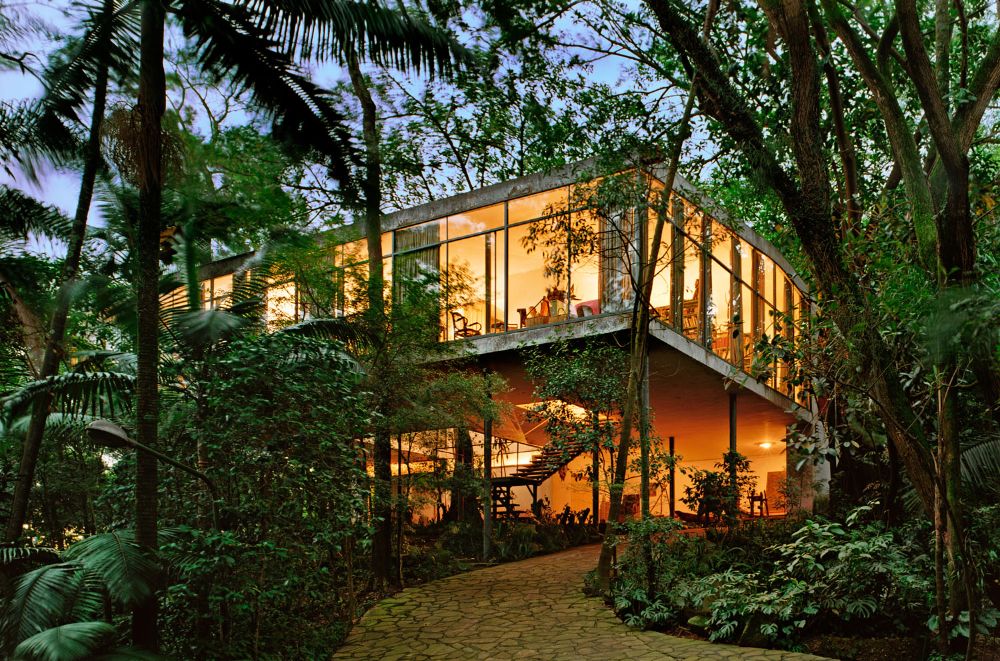
7 MIN · 5 OBJECTS IDENTIFIEDIt is the first house she ever built. She is twenty-seven, freshly arrived from Italy with a husband, a brand-new passport and the conviction that modern architecture can be made inside the forest — not against it. She chooses to set a glass box on four steel pillars in the middle of the Atlantic forest, in Morumbi, then the still-wild edge of São Paulo. Seventy-five years on, the Casa de Vidro remains the interior most often cited by contemporary architects as their absolute reference, and one still enters it as one enters a manifesto.
The gesture
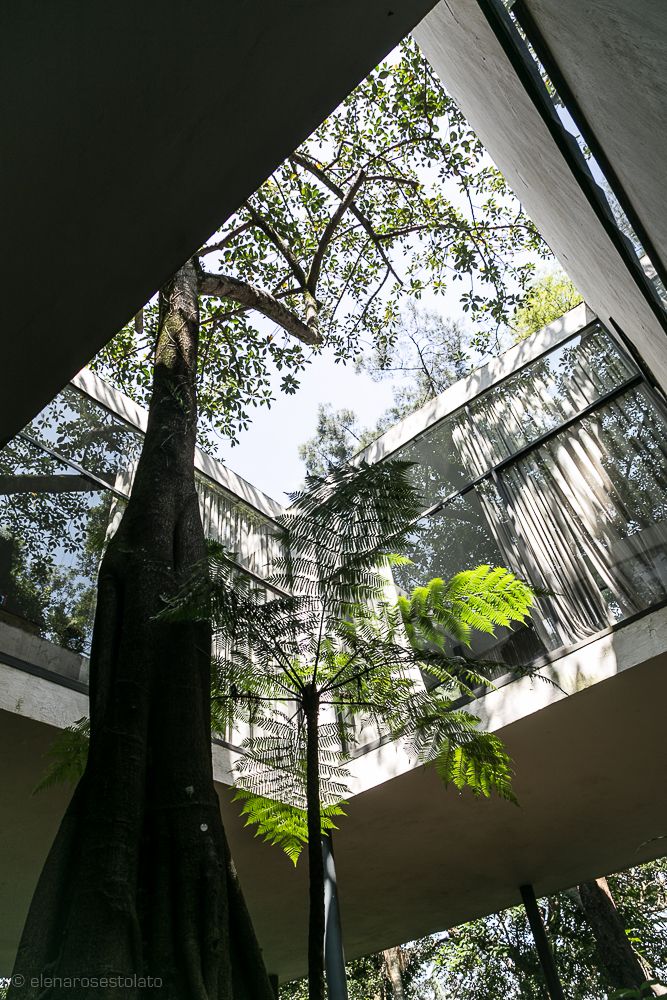
Lina Bo Bardi does not draw a house: she draws a point of observation. The floor lifts four metres off the slope, which lets the canopy cross the living room through a central opening, and the glass vanishes into the foliage the moment the rain begins to fall. Inside, one literally lives in the tree — the house is an inhabited belvedere, an outpost suspended above the forest.
The gesture is radical for the time. In 1951, modern Brazil is obsessed with solid volumes, raw concrete walls, opacity — Niemeyer is laying out Brasília, Lúcio Costa is setting down the principles of the Plano Piloto. Bo Bardi takes the opposite line: she hollows, she airs, she makes the house permeable to São Paulo's low light and to the warm winds that descend from the plateau. She sets a single rule: that nothing inside should try to compete with the outside.
The twelve objects that make the room
1. The blue Venetian mosaic floor
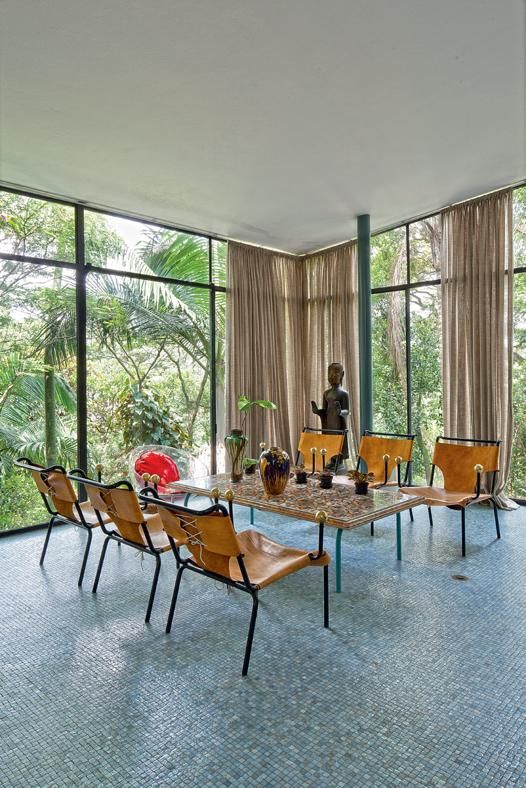
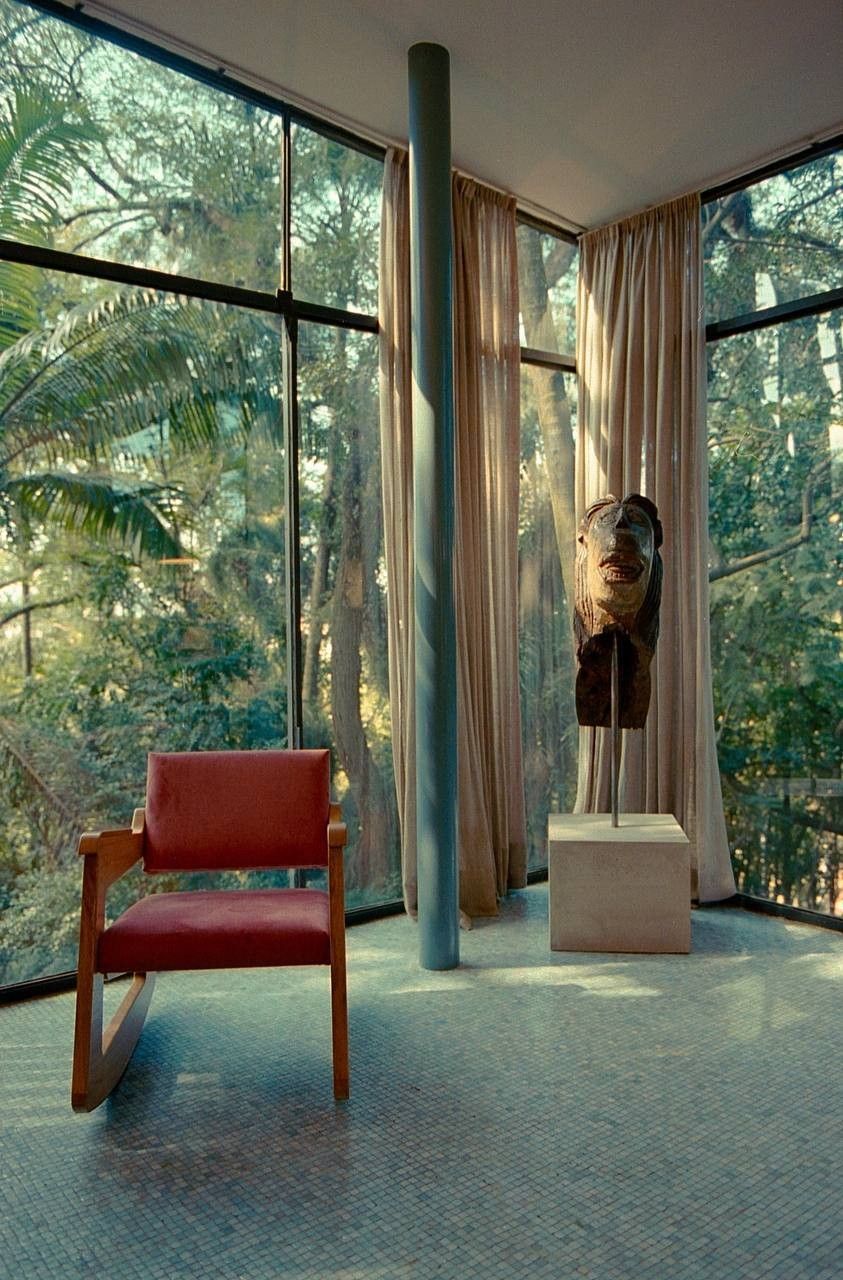
Shipped from Italy in wooden crates, laid by hand by craftsmen she brings over from Murano, with an irregular grain so the surface is never quite flat. The colour shifts with São Paulo's light — sapphire in the morning, turquoise around noon, storm-grey at the end of the day, when the tropical rain hits the glass. She never lays a rug in the house: the mosaic is the rug. The cold under a bare foot is part of the room, a climatic given like any other.
2. The raw Pau Marfim coffee table
Cut from a single trunk, set on four invisible feet. Dimensions: 220 × 90 × 35 cm — outsized, almost cumbersome. A sculptural piece that tells nothing but the story of the tree it comes from. Pau Marfim, a pale ivory wood veined with yellow, is a Brazilian timber Bo Bardi rediscovers as she moves away from noble European species. She would later write: "I learned matter on arriving in Brazil, not in Rome."
3. The Bowl chair, which she designs in 1951
A half-globe in vegetable-tanned leather, resting on a metal ring that lets it pivot a full three hundred and sixty degrees. It tilts, it invites lying back to read, it permits the asymmetric sitting position that Western armchairs refuse. It returns in a limited edition with Arper in 2014 — five hundred examples sold in forty-eight hours. Today, an original Bowl surfaces occasionally at public sales in Milan or São Paulo, and regularly clears thirty thousand euros.
4. The Frei Egidio chair, in jacaranda and leather
Three around the dining table, never four. The asymmetry is deliberate: Bo Bardi always dined for three, at the corner table, the guest facing the forest. Brazilian jacaranda, dense and dark, has since been listed in the appendix of the CITES convention — the chair is now a piece impossible to reproduce in its original material.
5. A bare bulb pendant
No signed light fixture. A simple filament bulb at the end of a black cord, three metres long, dropping from the laminated pine false ceiling. The house declares it will not compete with the forest — that no object should, at nightfall, screen the canopy as it fades to orange. Bo Bardi loathed what she called "lamps that play pretty".
6. The low black leather sofa
Set against the stone back wall, like a waiting bench. Bo Bardi hated deep sofas, which she associated with bourgeois passivity. Hers has a seat depth of seventy centimetres — you sit, you do not sink, you stand up easily to go to the library or the garden. The black leather, chosen to age while remaining legible, today shows a velvet patina that no contemporary designer manages to reproduce industrially.
7. A Bahia ceramic, on the floor
Beside the hearth, with no plinth. Red clay, raw glaze, an irregular ovoid form. It is not a decorative object: it is the echo of a journey she would later make, in 1958, to found the Museu de Arte Moderna da Bahia in Salvador, and which would lastingly transform her relation to craft. The piece is anonymous, bought from a market potter: Bo Bardi made a point of never collecting names.
8. A bookcase opening onto the foliage
Seven jacaranda shelves, backless, fixed into the glass by almost invisible steel brackets. The books cut out against the leaves outside. The effect: each book becomes a small set on a shifting backdrop, and the visitor never quite knows whether they are looking at the cover or at the leaves. Bo Bardi shelved by colour and by height, never alphabetically — she said the alphabet was the end of looking.
9. The central fireplace in raw stone
Conceived as a monolith cut from a single block, with no visible joint. It does not separate the living room from the rest — it anchors it. It is one of the rare vertical elements in a hyper-horizontal house, and probably the only one that works as a sculptural reference. The wood burns there two or three times a year, in the season of cool altitude nights: São Paulo sits high, and the house freezes, sometimes, in July.
10. A Lasar Segall painting
The only one hung on the wall. All the other art — gouaches, prints, drawings by friends — is propped, never fixed. The house stays mobile, reconfigurable. Bo Bardi said the ideal interior should be able to rewrite itself in fifteen minutes, and she did in fact move the works around every month. The Segall, the single exception, had been given to her by the painter himself: one hangs a gift, one does not lean a gift.
11. The writing desk in laminated pine
Turned toward the foliage, never toward the room. She writes facing outside. The rule is explicit in her notebooks: "never work facing a wall" — she thought mental fatigue came less from the subject than from too short a horizon. The desk is narrow, seventy centimetres deep, just enough to hold a notebook and an Olivetti typewriter.
12. A climbing plant that runs through the house
A monstera deliciosa, planted outside three years before the site was finished, passing through an opening cut deliberately into the glass, skirting a beam, and emerging through the roof. The forest is not a backdrop: it crosses the room, perforates the envelope, signals that the inside/outside border is negotiable. Bo Bardi pruned the plant herself, once a month, standing on a carpenter's ladder.
The context: São Paulo in 1951
To grasp the radicality of the gesture, one has to step back into post-war São Paulo: a megalopolis going in a decade from one million to three million inhabitants, where the Italian and Germanic architects who fled fascism are inventing a tropical modernism at forced march. Bo Bardi, a student of Gio Ponti in Milan, lands in this ferment with a conviction inherited from the war: that a house is never innocent, that it is always a position taken. The Casa de Vidro, set on a plot she buys on credit, is not a loud manifesto — it is rather a silent demonstration that one can inhabit lightly a crushing climate.
What the Casa de Vidro teaches us in 2026
The most contemporary idea in this house from 1951 is that it does not seek to dominate the outside, nor to quote it politely. It makes itself porous to it. Bo Bardi put it this way: "luxury is not having, it is letting in". The glass is not an aesthetic end, it is a tool of transparency. The house is, literally, a device for attention.
In 2026, as interiors return to warm matter, to wood, to linen, it would be a mistake to think the Casa de Vidro is past its time. It still poses the only question that counts: what do we let into the living room? Bo Bardi's answer is radical: the forest, the rain, the changing light, the neighbour walking the path below, and three chairs around a table — never four.
One photo, every piece identified.
Your room, a shop window, an inspiration screenshot: send the photo, we find the pieces and their alternatives at every price.
On iPhone, the app does the same from your camera.
The pieces, at your budget.
Every piece mentioned, with its alternatives — from vintage to dupe.


Gallery
4 images