The Floating Bedside Table: The Right Height, the Right Fixing, and for Which Bed
Mounting height aligned with the mattress, a depth that spares your hip, a fixing to suit the wall: the guide to the floating bedside table, from choice to install.
3 MIN · 5 OBJECTS IDENTIFIEDThe floating bedside table has won over bedrooms for one simple reason: it frees the floor. Fixed to the wall, it makes the room look larger, lets the vacuum pass beneath, and gives the bedroom that lightness of a well-drawn hotel. Three decisions do all the work: height, depth, fixing.
Why float it rather than stand it
A piece of furniture that never touches the floor looks smaller than it is — the eye reads the skirting board carrying on, and the room breathes. In a narrow bedroom where every centimetre of passage counts (60 cm minimum on each side of the bed, see our guide to bed dimensions), it is often the only way to have a proper bedside table without sacrificing circulation.
Mounting height: aligned with the mattress
The rule is the same as for a standing bedside table: the top at the height of the top of the mattress, give or take 5 cm. With a standard sleeping surface at 50-55 cm from the floor, that places the top of the table between 55 and 65 cm. A low, seventies-minded bed brings the table down with it; a high base lifts it up. You measure your own mattress before you drill — never the other way round.
Depth and width: the format that doesn't knock
35 to 40 cm of width is enough for the essentials — lamp, book, glass of water. Depth, on the other hand, should stay at 30-35 cm: beyond that, it's the hip meeting the corner every morning. A drawer beats an open niche: the floating bedside table sits at eye level, and so does the clutter.
The fixing: it's the wall that decides
On a load-bearing wall (brick, concrete, stone), any model can be fixed with the plugs suited to the material. On a plasterboard partition, you need expansion anchors and the fixing specified by the manufacturer — never a simple screw into the board. And you reason in terms of real load: a lamp and three books weigh nothing, but a hand pressing down in the dark does. When in doubt, aim for a stud in the partition.
Wood, lacquer, metal
Warm wood softens the geometry of the suspended box and converses with a wooden headboard. Lacquer turns the bedside table into a flat plane of colour — lovely in a muted tone, sage green or terracotta, rather than a garish primary. Metal, rarer, holds the workshop register. In every case: two identical bedside tables are not compulsory, two aligned heights are.
For which bed — and when to give it up
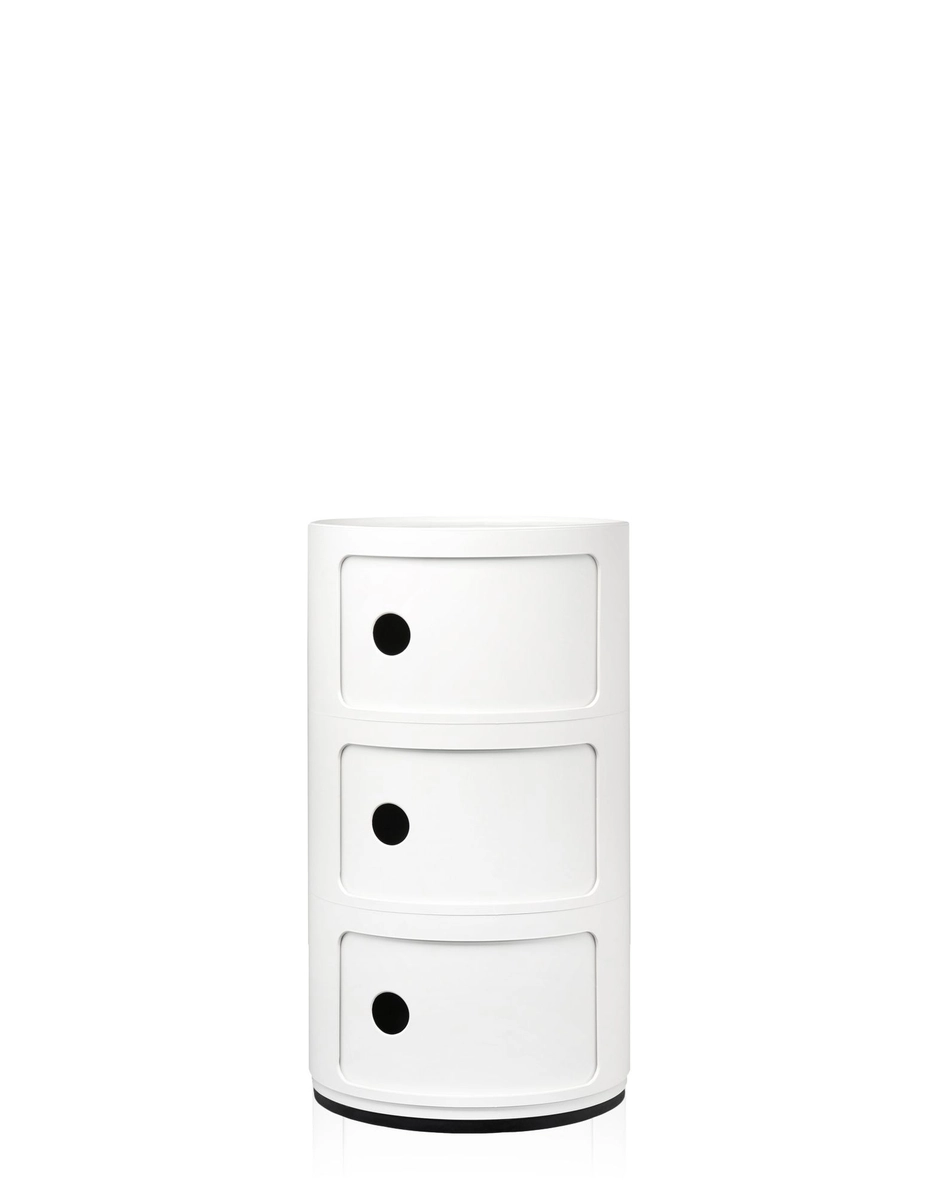
The floating bedside table loves clean beds: platform, straight headboard, contemporary frame. Faced with an antique bed with a high frame and turned legs, it jars — better then a low vintage chest of drawers as a bedside. And between the two, there is a third way that has become a classic: the Componibili by Anna Castelli Ferrieri, a cylinder set on the floor that gives the same lightness without drilling a single hole — the tenant's friend.
The Beyit tip
Before drilling, tape a paper template to the wall at the exact dimensions of the bedside table, at the calculated height, and sleep a night with it. It's the only test that reveals the elbow that catches and the lamp that sits too high. And nothing obliges symmetry: a floating bedside table on one side, a sculptural stool on the other — the room gains in character what it loses in mirror image.
Spotted a bedside table in a photo?
If a bedside table stops you in a bedroom photo, scan it: Beyit identifies the model and offers the original and its alternatives at every price.
One photo, every piece identified.
Your room, a shop window, an inspiration screenshot: send the photo, we find the pieces and their alternatives at every price.
On iPhone, the app does the same from your camera.
The pieces, at your budget.
Every piece mentioned, with its alternatives — from vintage to dupe.


