
Savoir Faire Savoir: two weavers open the Galeries Lafayette archives
The first edition of a grant that sends designers into a department store's archives. The winners bring back wearable furniture.
5 MIN · 5 OBJECTS IDENTIFIEDA hundred-and-thirty-year-old department store keeps more objects than it has ever sold: catalogues, models, sales counters, fabrics, index cards. This material almost always lies dormant. With Savoir Faire Savoir, Galeries Lafayette reopens it and installs contemporary designers inside, tasked with bringing back an unpublished object. The first edition is on show at Le Gourmet, from 8 to 20 September.
How the grant works
The Bourse des Regards does not fund an open project: it funds an immersion. The selected designers enter the store's historic archives, and the object they conceive must echo the department store's heritage — through its aesthetic, its function or its craft. It is a constraint of method, and it is more interesting than an open commission: it forces you to look at a collection before drawing, and it produces objects with a verifiable source rather than a declared inspiration.
The programme lays claim to a policy in favour of the applied arts. In a sector where most collaborations between a retailer and a designer consist of putting a name on an existing series, making the memory of a place converse with current creation is a more demanding position — and a harder one to sell in a window.
The winners: Les Moires
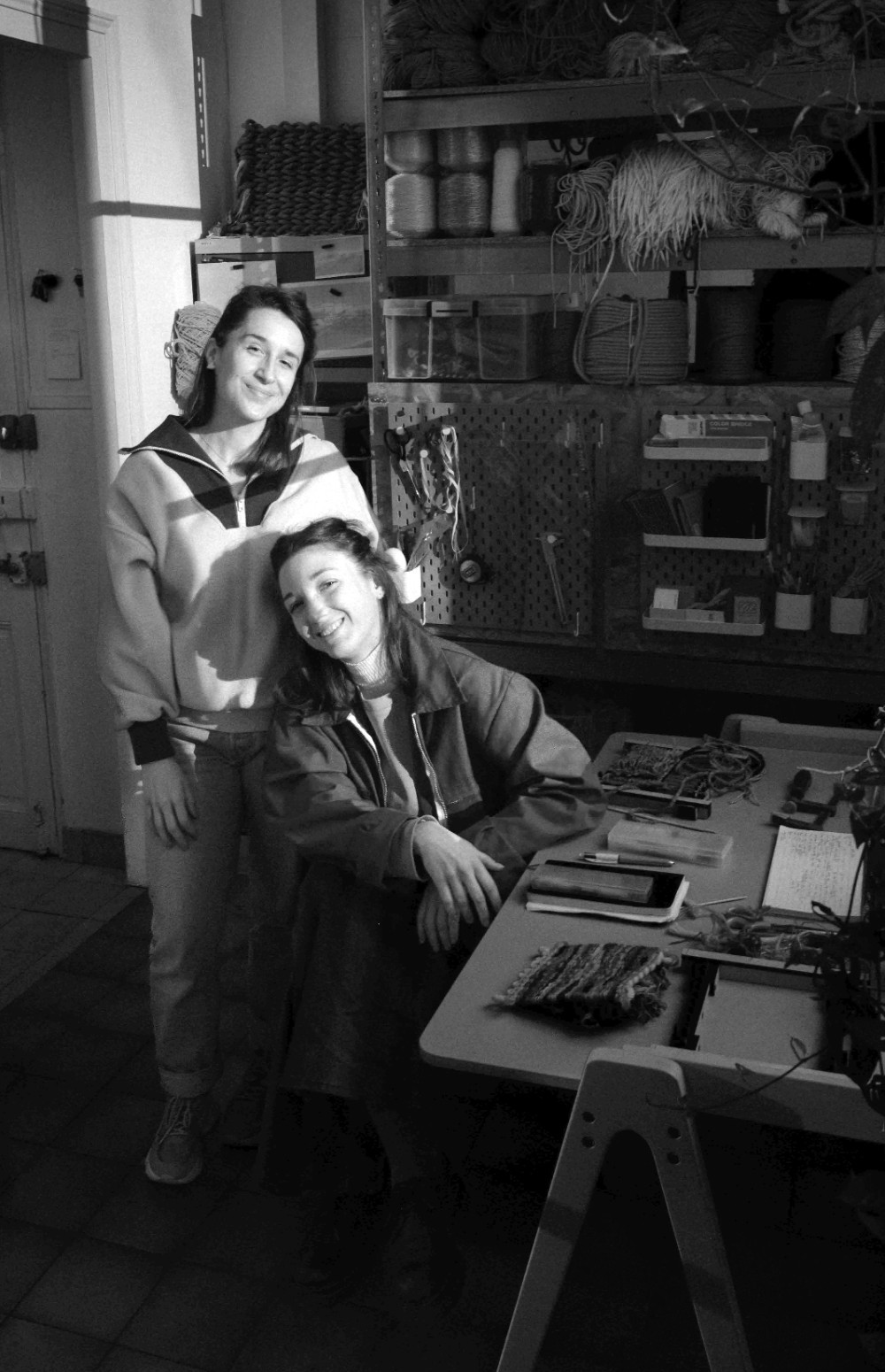
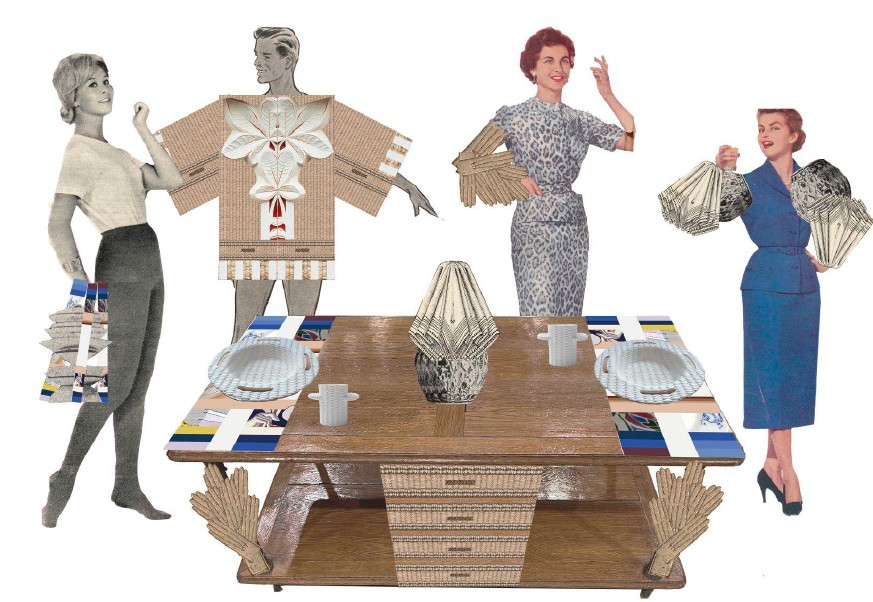
The 2025-2026 winners are Les Moires, a Parisian weaving studio led by Camille Gasser and Camille Mouchet. Their project is called Meuble-à-porter, and the title contains the whole argument: a modular textile collection sitting at the crossroads of clothing, furniture and installation.
The starting point is a precise object drawn from the archives: the historic sales counter, the one the saleswoman stood behind and across which the merchandise was unfolded. Les Moires turn it into a mobile, intimate object, one you wear. The shift is twofold. A counter is a piece of furniture that separates — there is a customer side and a seller side; by making it portable, the designers remove the line. And a furniture textile is usually a surface stretched over a structure; here it becomes the structure itself, held by a body rather than by a frame.
That this work comes from a weaving studio is not incidental. Weaving is one of the few crafts where matter and form are decided in the same gesture: you do not draw a cloth and then make it, you make it by drawing it. That is exactly the logic of a piece of furniture that takes its form the moment someone slips it on.
Two guests of honour
The first edition opens with two invitations, one per section.
On the fashion side, Stéphanie D'heygere presents The Brush Clutch. Her practice consists of subverting everyday objects and, as the press file nicely puts it, accessorising accessories: humour here is not a veneer, it is the method. A clutch that is a brush poses exactly the question that Meuble-à-porter poses, in reverse: at what point does an object stop being what it is used for?
On the design side, Döppel Studio — Lionel Dinis-Salazar and Jonathan Omar — presents Reflets, which takes the porcelain service and moves it from the table to the wall. The plate becomes an interior accessory, outdated ornament becomes a contemporary game. The piece is made in mirror-glazed ceramic by the Manufacture de Charolles, a living-heritage company, French-made and shaped by hand. Precision is what counts here: the word "craft" is not invoked, it is attributed to a workshop you can go and see.
Why Le Gourmet
The choice of venue is worth noting: the exhibition is not in an art space cut off from the store, it is at Le Gourmet, that is, on a floor where people come to buy food. A research object placed on the path of a customer who had not come for it is subjected to a test no gallery knows — it has to stop someone who was looking for nothing. It is the most demanding format one can give a creative grant, and the most honest with regard to what a department store is.
What these archives contain
We barely grasp what a department store accumulates over a century and a half. Among the documents the store supplied for this exhibition is a catalogue from the sixties — the kind of object that, on its own, holds a complete state of the domestic taste of an era: what was sold, at what price, under what name, and above all in what order things were presented. For a designer, such a collection is not a source of inspiration in the vague sense, it is a database of forms that were made, sold and used, with proof of their circulation.
This is precisely the type of material missing from the history of everyday furniture. We document designer pieces very well; we document very poorly what people actually had at home. A grant that sends designers into these boxes therefore produces something other than an object: it produces a reading, and that is what distinguishes this exhibition from a commercial collaboration.
Ten pieces, and three glasses
Les Moires produced ten specific pieces for Meuble-à-porter. They are presented on the second floor, and you do not try them on: they are exhibition pieces, not fitting rooms. A booklet accompanies them, and a mediator is on site to present the project to customers — which, for an object placed in the middle of an aisle, is worth more than a label.
In resonance with the project, the designers have also issued three glasses: an identical form for all three, a different motif on each, each glass in an edition of eight. They are sold at Galeries Lafayette, €120 apiece. It is the only object in Savoir Faire Savoir you can take home, and it was born of the same immersion in the archives as the furniture.
Why it is an address apart
Galeries Lafayette is one of the few places where, within the same hour, you walk past mass-produced furniture, a designer piece and a unique object — with nothing signalling which is which. That is exactly the problem our tool tries to solve: photograph a piece and know instantly whether it is editioned, by whom, at what price, and whether a more affordable version exists. In front of a piece from Savoir Faire Savoir, the answer will be the reverse of the usual one: this one exists only here, it was born of an archive, and that is what makes its value. The three glasses, for their part, come in eight copies — and that is already an edition.
Going there
Galeries Lafayette Paris Haussmann — Savoir Faire Savoir, at Le Gourmet, second floor. From 8 to 20 September 2026. Booklet and mediator on site; the three Les Moires glasses are for sale, €120 apiece. The exhibition covers the whole of Paris Design Week and spills over on both sides: it opens two days before and closes the day after the finish. It is one of the only addresses in the OFF you can see without slotting anything into your diary.
The Beyit gesture: photograph a piece, scan it — the tool tells you whether it is editioned, where to find it, and what exists only here.
One photo, every piece identified.
Your room, a shop window, an inspiration screenshot: send the photo, we find the pieces and their alternatives at every price.
On iPhone, the app does the same from your camera.
The pieces, at your budget.
Every piece mentioned, with its alternatives — from vintage to dupe.


Gallery
1 image