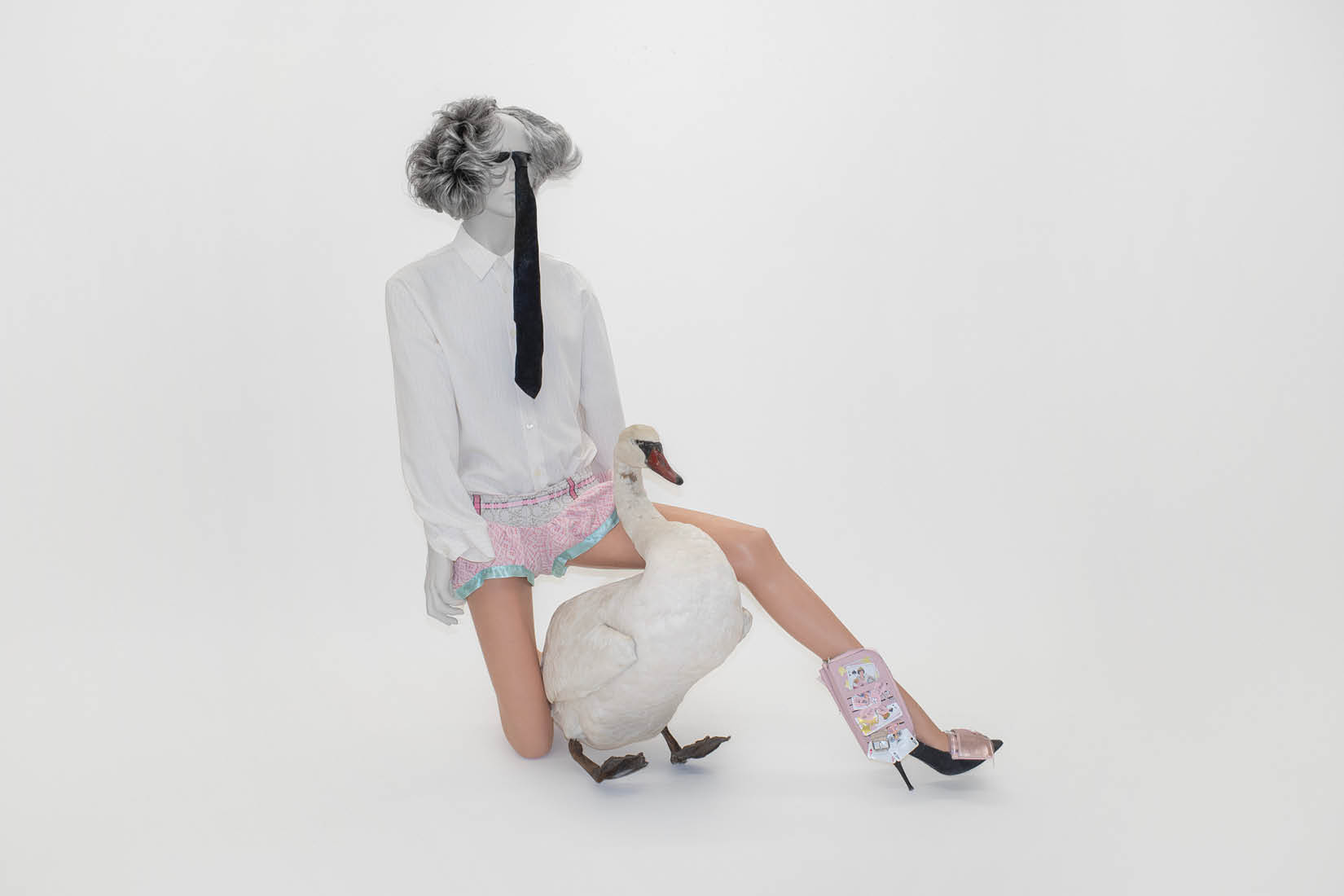

Everything Is in Order: the Swedish Institute Puts Swedish Good Taste to the Test
Until 4 October, on rue Payenne, an art and fashion exhibition probes Swedish restraint: some twenty mannequins with impossible proportions, four artists and designers, five fashion houses. Free entry, late opening on Thursdays.
3 MIN · 1 OBJECT IDENTIFIEDThere is a Swedish idea of good taste: order, restraint, neutrality. The Swedish Institute, on rue Payenne, has laid it out on the table until 4 October — not to celebrate it, nor to reject it, but to watch what happens when it is disturbed a little.
The principle
Everything Is in Order begins with the smallest of gestures — queuing, waiting your turn, behaving well — and lets them drift. Curated by Nicole Walker, the exhibition assembles silhouettes, sculptures, sounds and images with no apparent hierarchy: recomposed mannequins, of uncommon proportions and blurred identities, form queues that lead nowhere. Everything seems to want to be right; something resists, slips, escapes. This is the tension the exhibition sustains from one room to the next: between order and distortion, the neutral and the identity, the ordinary and the absurd.
What you see
The route opens on the ground floor with a suspended mannequin turning slowly on itself, then climbs to the first floor, into a densely populated room: some twenty figures standing, lying down, perched on the antique cabinets of the Hôtel de Marle. Their attributes are those of an everyday life gone wrong — an arm that ends in a walking stick, a vacuum-cleaner hose, a wooden leg shod with a deer's hoof, a crutch, a lead.
The clothes come from five Swedish fashion houses of different generations, from the most established to the youngest: Our Legacy, Hodakova, Per Götesson, LLL and Love is Shouty but Iconic. The label fades away; what counts is the relationships between the pieces. A shirt and a tie by Our Legacy, shorts by LLL, shoes by Love is Shouty but Iconic on the same figure: this is the image that opens the exhibition, and it sums up the method. Fashion here is no longer a product or a fixed image, but a system in motion, fragile, dependent on context and on the gaze.
The art that disrupts the fashion
Four artists and designers occupy the same rooms: Anton Alvarez, Anna Uddenberg, Klara Zetterholm and Simon Skinner. Their role is not to illustrate the clothes. It is to block the silhouettes, to interrupt the gaze, to introduce friction. Alvarez is known for his machines that make objects in his place — the Thread Wrapping Machine, which wraps furniture in thread, the ceramic extruder; Uddenberg for her female bodies folded into comfort devices that resemble seats. In an exhibition about dress, these two vocabularies are not there by chance.
Why this address
The Swedish Institute is the only Swedish cultural centre outside Sweden. Since 1971 it has occupied the Hôtel de Marle, a sixteenth-century private mansion in the Marais, with a garden, a café, a permanent eighteenth-century collection — the portraits of Alexander Roslin, the century of Carl Gustaf Tessin — and a programme that ranges from photography to a Nordic film club. Entry is free. This week the exhibition is presented as part of Paris Design Week and on the eve of Fashion Week: it is one of the rare addresses of the OFF where you can step in for an hour without having to buy anything, and where the setting is as worth the visit as the hang.
What stays with us, on the object side
For us, the interest lies elsewhere than in the fashion. The Swedish design we keep at home — the String shelf, the 1960s writing desk, the birch chair — comes precisely from this culture of order and restraint that the exhibition disturbs. Going to see what artists make of it is also a way of asking where what we own comes from, and why we chose it.
The programme
Getting there
Institut suédois — 11 rue Payenne, 75003 Paris, métro Chemin Vert or Saint-Paul. Everything Is in Order, from 2 September to 4 October 2026. Tuesday to Sunday from 12 noon to 7 p.m., late opening on Thursdays until 9 p.m. Free entry, no booking.
The Beyit gesture: photograph a piece in these rooms — a chair, a cabinet, a lamp — and scan it: the tool tells you who makes it, at what price, and what exists around it.
One photo, every piece identified.
Your room, a shop window, an inspiration screenshot: send the photo, we find the pieces and their alternatives at every price.
The pieces, at your budget.
Every piece mentioned, with its alternatives — from vintage to dupe.
