
Reading a rug from the back: hand-knotted, flat-woven or tufted, the back tells all
Visible knots, flat weft or glued backing: three backs, three constructions, and the clues — wool, viscose, fringes, smell — to know what you're buying.
1 MIN · 7 November 2026The face of a rug sells, the back tells the story. Turn it over first thing, in a shop as at a flea market: the construction reads in ten seconds, and it is what sets the price.
Three backs, three constructions
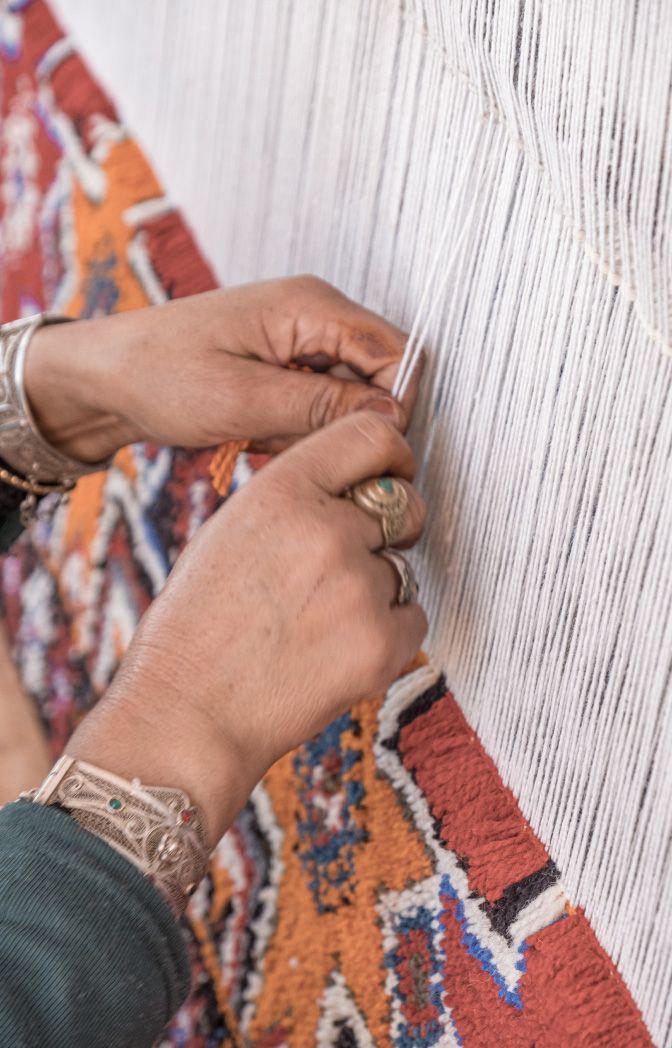
Hand-knotted: on the back the pattern appears in negative, knot by knot, with irregularities of line and colour. Flat-woven: this is the kilim, no pile, front and back almost identical. Tufted: the face is punched into a backing with a tufting gun, then glued onto a second cloth, often a uniform ecru cotton that hides everything; it is the most common in shops, and the one that smells of latex when you bring your nose close.
Density, material, fringes
On a hand-knotted rug, density is counted on the back over a centimetre in both directions: an ordinary wool rug runs around 100,000 knots per square metre, fine pieces more than double that. Wool is matt, warm, a pulled thread burns with the smell of hair; viscose, sold as “bamboo silk” or “art silk”, shines, crushes underfoot and marks at the first drop of water. The fringes of a hand-knotted rug are the warp coming out of the rug; those of a tufted rug are sewn on at the edge.
What it is worth
A wool tufted rug costs a few hundred euros in a large format, a viscose tufted one less; a hand-knotted wool rug in 2 by 3 metres starts around a thousand euros and climbs quickly according to origin and age. We have dealt with rug sizes elsewhere; here, only what lies underneath counts.
Spotted a rug in an interior? Scan it on Beyit: type, likely origin, value.
One photo, every piece identified.
Your room, a shop window, an inspiration screenshot: send the photo, we find the pieces and their alternatives at every price.
On iPhone, the app does the same from your camera.
Gallery
4 images