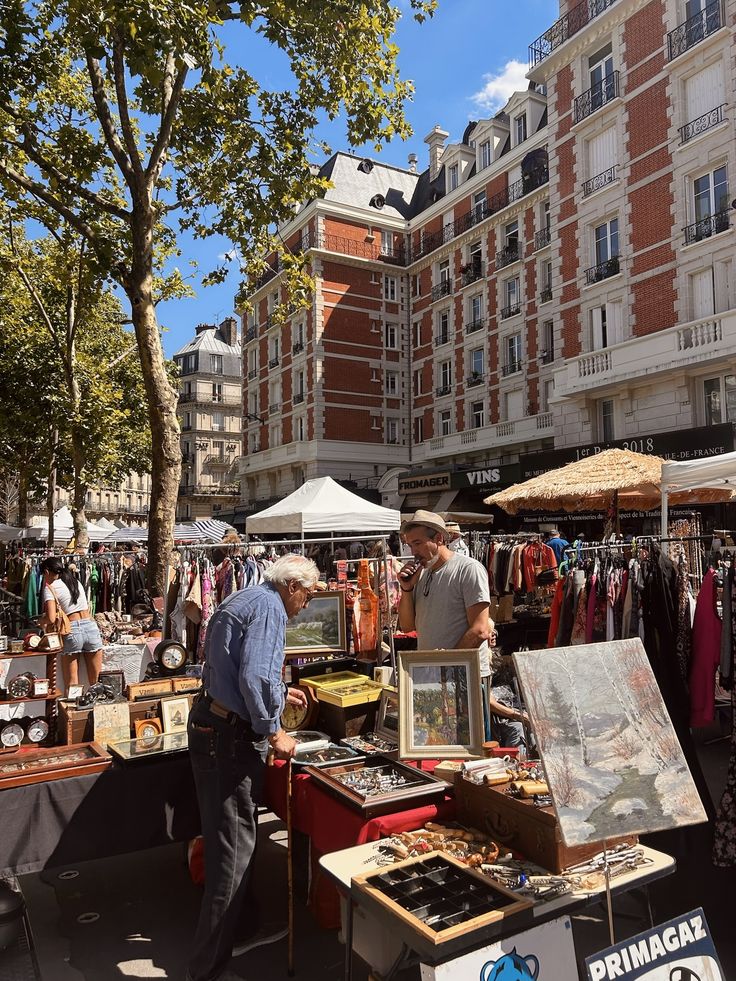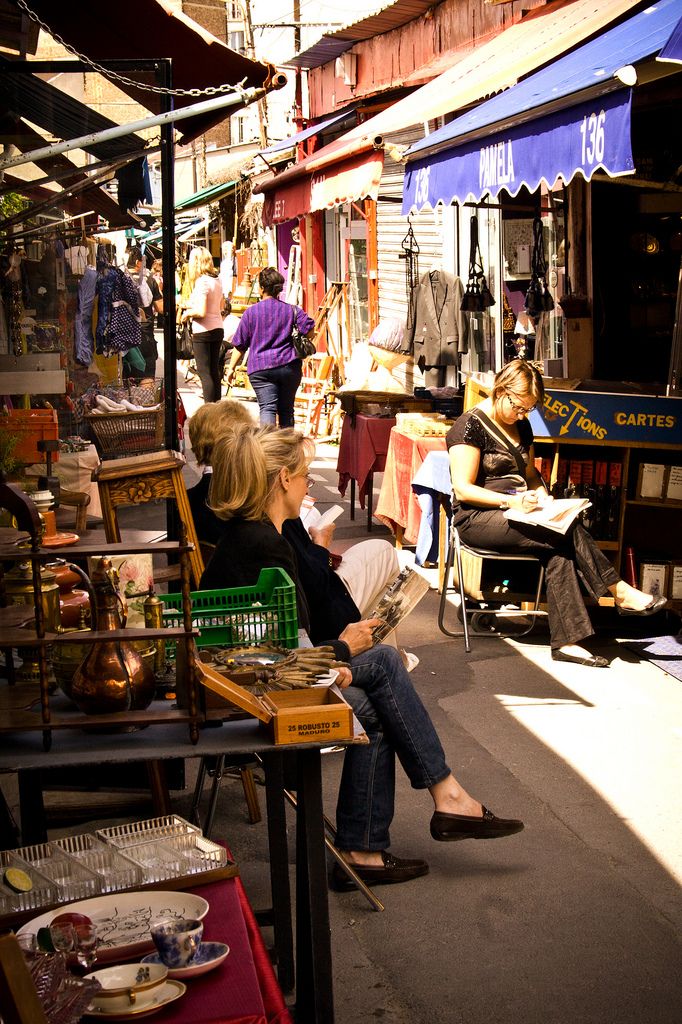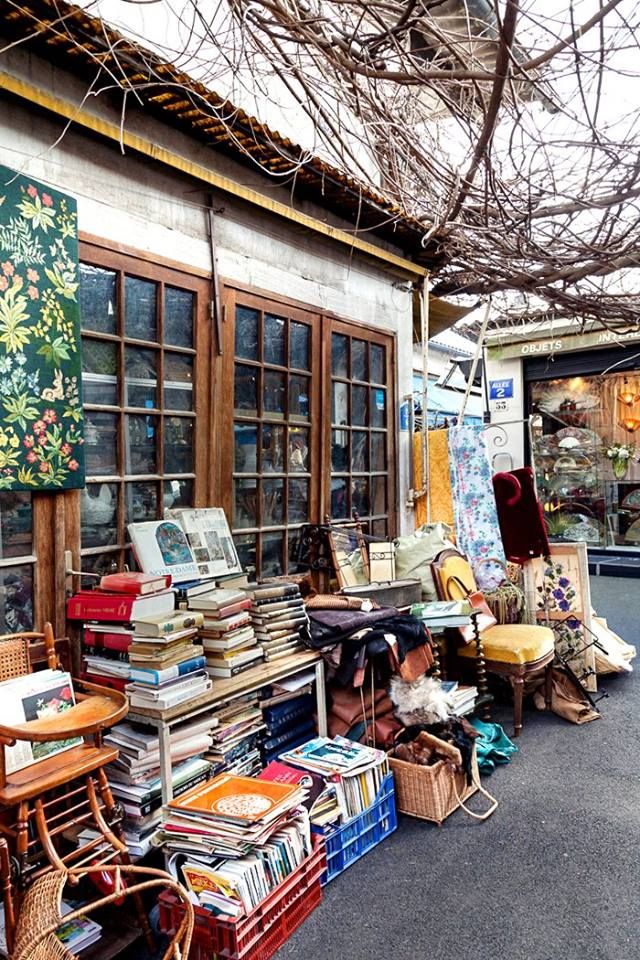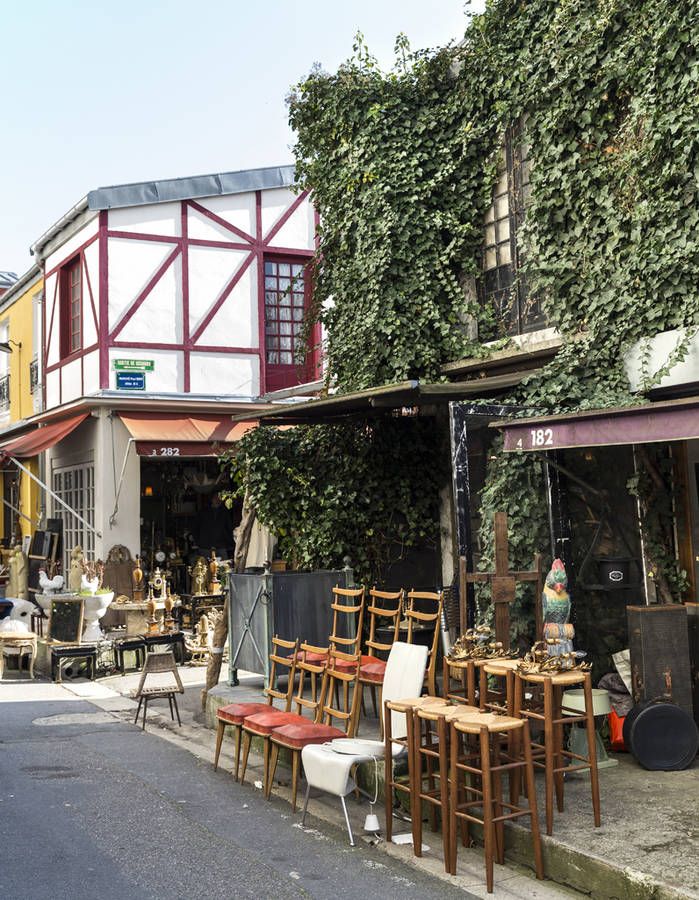
Saint-Ouen flea market, allée Paul Bert
Three hours in the most honest aisle of the market. What to see, what to avoid, where to lunch.
6 MIN · 5 OBJECTS IDENTIFIEDSaint-Ouen is seven different markets jammed against one another like a patchwork inherited from the nineteenth century, two thousand five hundred dealers spread across seven hectares, and prices ranging from one hundred euros to two hundred thousand for a commode stamped Boulle. Over the past decade it has also become the most touristed flea market in the world — coachloads of Asian visitors, prices inflated for foreign profiles, gallerists who live more off the online secondary market than off direct sales. Within this magma, the allée Paul Bert is the only one still holding the historical standard of the place, the only one where the real twentieth-century furniture dealers still set up on Saturday morning and argue about the latest Prouvé to come up at auction. Here is how to walk it in three useful hours, with the six stands that genuinely warrant the visit.
The Paul Bert market, briefly
Opened in 1946 by Paul Bert, a junk dealer from Saint-Denis who had collected entire lorry-loads of furniture from the Parisian town houses emptied during the War. Seven aisles numbered 1 to 7, around two hundred and twenty gallerists spread across stands of eight to twenty-five square metres, in the open air beneath the original glass canopies. Specialised in twentieth-century furniture — Prouvé, Perriand, Royère, Mouille, Borsani, Albini — sold for real here (with gallery certificates of authenticity, sometimes with attestations from the rights holders for the major pieces). Saint-Ouen without Paul Bert is just a generic brocante market. With Paul Bert, it is still one of the three or four world capitals of post-war design. The Paul Bert dealers' union, founded in 1978, imposes strict authentication rules that the other markets in the complex have never adopted.
The six stands you must see
1. Aisle 1, stand 35 — Galerie Patrick Fourtin
French furniture from the 1930s to the 1950s: Adnet, Royère, Arbus, Frank. Fourtin has known his subject for forty years, and is one of three French experts officially recognised by Drouot to authenticate Royère pieces. Pieces are attributed rigorously, sold with their written history of provenance. The absolute reference for French mid-century between 8,000 and 80,000 euros. Note: Fourtin refuses to haggle, but offers fair prices from the start — no point negotiating.
2. Aisle 2, stand 78 — Frédéric de Lyon
Specialist since 1995 in Vallauris ceramics (Picasso, Capron, Innocenti, Estève, Derval). He is the only dealer in Paris to consistently have three Caprons available in stock, at prices holding between 800 euros (small flat plate) and 12,000 euros (large vase). He authenticates each piece with his stamp on the underside and guarantees buy-back at purchase price within five years — a rare clause in the trade. Vallauris Picassos (plates edited by Madoura, 1950s-60s) sit between 4,000 and 15,000 euros depending on the motif and the rarity of the edition.
3. Aisle 3, stand 112 — Brigitte Croizet
Industrial lighting and decorative arts. Her Mathieu Matégot lamps are authentic (sold between 1,800 and 4,500 euros depending on the model), fairly priced, sold with their history. She also offers Jielde table lamps restored with original parts, and 1960s enamelled Sammode ceiling fixtures — the finest Parisian selection in this segment. Good school for beginners: Croizet takes the time to explain the difference between an original Jielde Loft and a contemporary Jielde reissue.
4. Aisle 4, stand 145 — Galerie Half
Scandinavian furniture: Wegner, Juhl, Mogensen, Wanscher, Wegner. High prices but unavoidable for anyone collecting Danish — a PP19 armchair (Bear Chair) by Hans Wegner sells here between 7,000 and 9,000 euros depending on the condition of the original leather. Vodder sideboards rarely go below 4,500 euros. The gallerist, Henrik Salonen, has been importing directly from Denmark since 2002 and knows the European collectors — you may well run into Jean Touitou or Inès de la Fressange at his stand on a Saturday morning.
5. Aisle 5, stand 191 — Galerie Olivier Watelet
The only French dealer who regularly offers authenticated Charlotte Perriand furniture — Ombra armchairs (1955 Cassina edition), original Méribel stools from the 1950s, Tonneau seats, Nuage shelves reissued by Cassina but sourced directly by Watelet. The absolute reference, and one of three European interlocutors of the Perriand heirs. Prices start at 4,500 euros (small Méribel stool) and climb to 35,000 euros (original-edition Ombra armchair). Watelet refuses to sell without a preliminary conversation to verify that the piece is destined for a coherent use.
6. Aisle 6, stand 220 — Galerie Christian Boutonnet
Silverware, tableware, Lalique crystal pieces. For those who collect designer tableware — Christofle cutlery from the 1930s, Puiforcat services by Jean Puiforcat himself, pre-1945 Lalique vases (the only ones that truly hold their value, the post-war pieces being industrial). Boutonnet is also a court-appointed expert for estate valuations, which guarantees the seriousness of the attributions.
What to avoid
Any stand that does not display a "member of the Syndicat National des Antiquaires" or "member of the Syndicat Paul Bert" plaque visibly at the entrance. These unaffiliated stands often sell restored-but-undeclared work (a repainted Jielde passed off as original), reassembled pieces (a Mouille seat with a shade added later), or worse, Vietnamese copies presented as French originals. At Paul Bert, the union guarantees authenticity through a system of fines and expulsion for offenders — without the plaque, refuse to pay more than 50% of the asking price, or ask the gallerist to have the piece authenticated at a neighbouring affiliated stand (ultimate test: if he refuses, leave).
Three types of classic traps are particularly widespread in 2026. Fake Mouille lamps (the real ones bear a mark on the underside of the shade and weigh a minimum of 3.2 kg for the desk model). Fake Wegner CH24 chairs (contemporary Carl Hansen reissues, sold at the price of the original, which do not appreciate). Fake Charlotte Perriand shelves (any piece without the Cassina mark on the underside is suspect, except for documented pre-1960 Steph Simon editions).
Where to lunch
Ma Cocotte, 106 rue des Rosiers — Philippe Starck designed the interior in 2012, terrace opening onto the market, revisited bistro cooking. Packed on Sundays, booking essential at least a week in advance. Reckon on 45 euros per head with a glass of wine. Panoramic view over the allée Paul Bert from the mezzanine.
Le Voltaire, 110 rue des Rosiers — less glamorous bistro but more honest cooking, run by the Berthier brothers since 1998. Daily special at 18 euros, decent wines by the glass (Loire, Beaujolais), quick service even on Sunday lunch. Frequented by the dealers themselves on weekdays, which is the best sign.
Habibi, 17 avenue Michelet — the Lebanese option for those tired of French bistros. Mezze between 8 and 12 euros, proper Arabic coffee, open late. Run by the Mokarzel family since 1985.
Practical
Marché Paul Bert — 18 rue Paul Bert, 93400 Saint-Ouen. Open Friday 8am-12pm (only for trade members, on presentation of SNA card), Saturday 9am-6pm (the fullest day), Sunday 10am-6pm, Monday 11am-5pm (the quietest day, therefore the best for negotiation). Métro Porte de Clignancourt (line 4) then a 10-minute walk along avenue Michelet, or line 13 Garibaldi then 8 minutes along rue Lyautey. Cash and card accepted depending on the stand, bank transfer possible for pieces over 5,000 euros. Avoid rainy days: half the stands close.
One photo, every piece identified.
Your room, a shop window, an inspiration screenshot: send the photo, we find the pieces and their alternatives at every price.
On iPhone, the app does the same from your camera.
The pieces, at your budget.
Every piece mentioned, with its alternatives — from vintage to dupe.



Gallery
4 images