DePliable: the piece of furniture that changes trade when you unfold its leg
Colomban de Mascarel shows five years of research on a single system: a deployable tripod that turns one object from stool to side table.
5 MIN · 5 OBJECTS IDENTIFIEDThere are two ways to make a folding piece of furniture. The first, the most common, takes an existing piece and adds a hinge: the result stows away, but it becomes nothing other than itself, only flatter. The second starts from the mechanism and lets the object follow from it. That is the one Colomban de Mascarel has chosen, and it is what he is showing on rue Commines from 7 to 13 September, under the name DePliable.
One leg, several trades
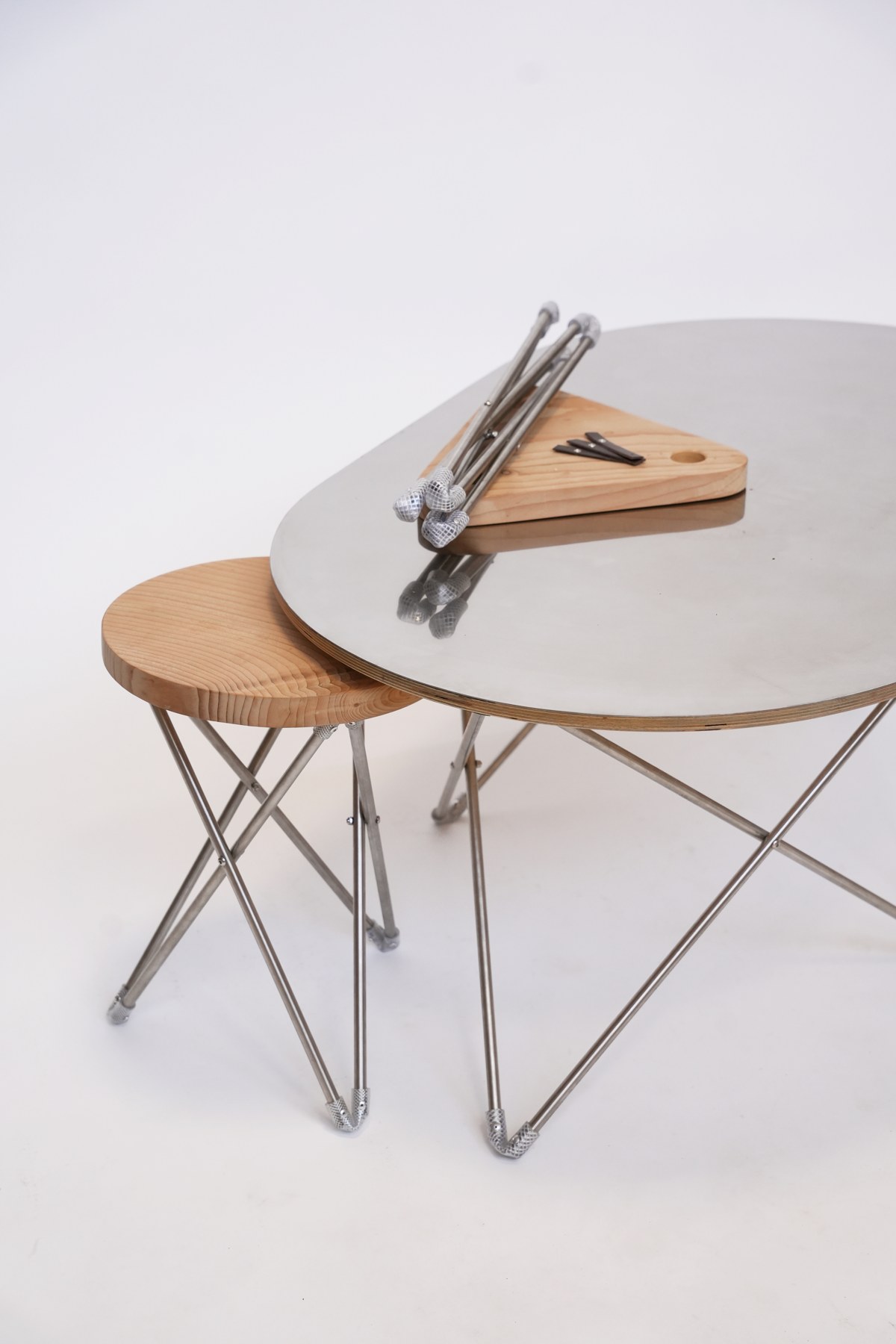
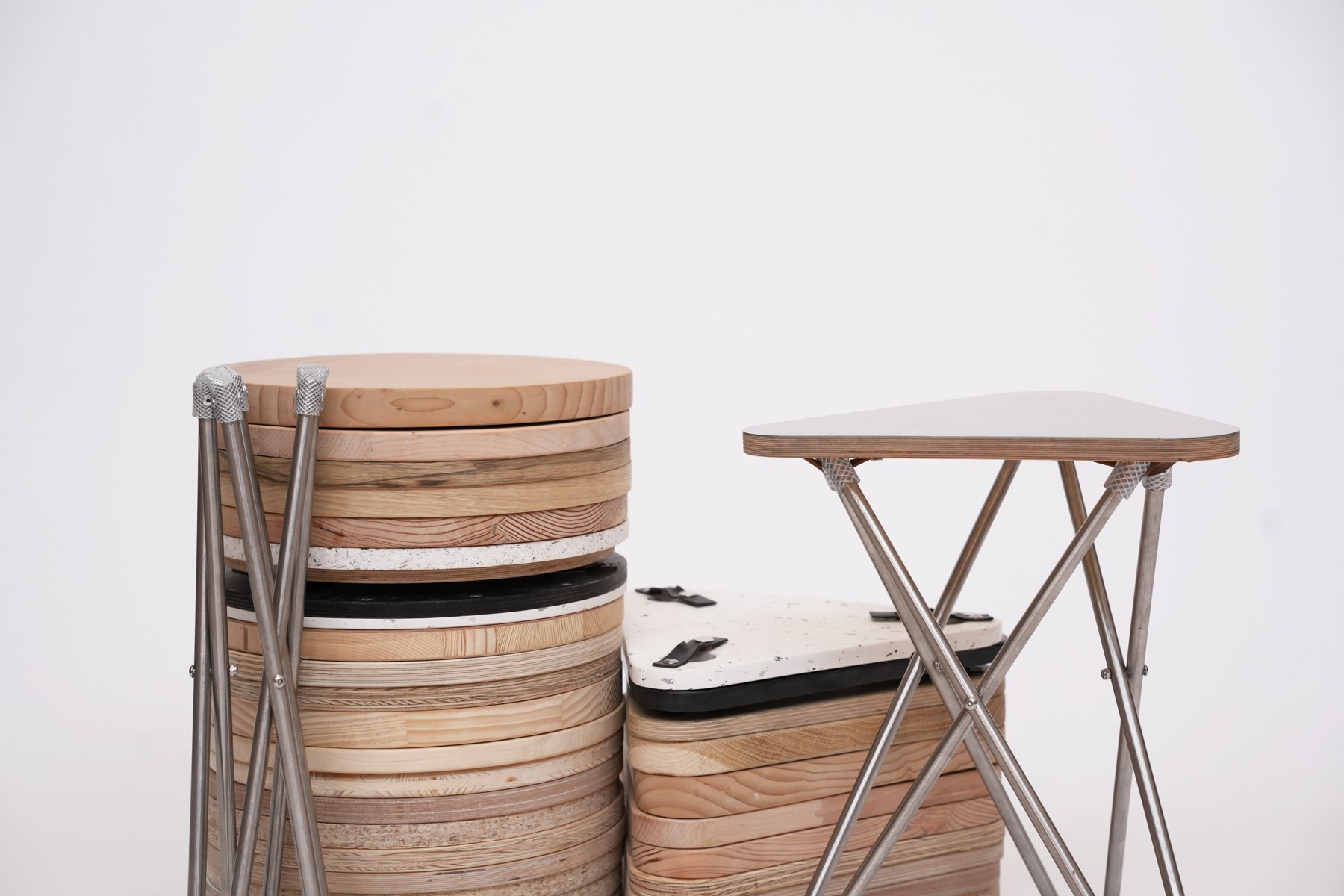
The system holds in a single sentence: a tripod whose legs deploy, and whose deployment varies the height. Once the height changes, the function changes with it. Folded low, the stool's leg is also a small coffee table; the high stool's leg becomes a 60 cm side table. The top does not move, nor does the structure — it is the angle that does the work. Beyond that, the system changes scale rather than angle: the 75 cm tables, the tops above 70 cm and the standing tables have their own structure, drawn to the same logic. Each combination produces a different silhouette and suggests a use, without anything having been added or taken away.
This shift has a consequence that is hard to gauge until you have the object in front of you: the structure can be a seat or a support, and the same leg can carry a coffee table or a side table, which means one and the same example replaces two or three pieces of furniture in a room. It is not a space-saving argument, it is an argument of number: you own fewer objects, and the one you own works harder.
What "circular" means here
The word has become so convenient that it no longer says much. In the case of the DePliables, it covers two verifiable gestures. First the material: the tops are made by hand from reused or recycled materials, and the workshop works that constraint upstream of the drawing rather than downstream. The structures, for their part, are in new materials — but the simplicity of the system and of the assembly means the whole thing can be repaired, taken apart, and therefore recycled. Then the length of use: an object that changes function at the same time as the life of the person using it leaves the circuit less quickly than an object designed for a single use. The workshop's explicit proposition is to offer an alternative to standardised folding furniture — the kind you buy for one summer and replace the next.
Five years in a single room
The exhibition does not present a new collection but a body of work: five years spent on the mobile, the modular and the circular. The pieces chosen each tell a transformation, and show the range of compositions the system allows. It is a rare format during Design Week, where the unwritten rule is to show only what comes out this year. Seeing the successive states of a single idea is more instructive than seeing ten separate ideas.
For this edition, the workshop has invited several craftspeople as well as makers of innovative materials to come and assemble on the tripod. The system then becomes a common base, almost an open standard: each brings their material or their top, the mechanics stay the same. It is the part of the exhibition that cannot be anticipated, and probably the one to go and see first.
What a designer who makes changes
The status of designer-maker has very concrete consequences, rarely spelled out. The first is price: with no editor or reseller, the intermediary's margin disappears, but the making time is paid for at its real value, which gives objects that are neither cheap nor speculative. The second is repair: an object whose author and workshop you know can be repaired, whereas an industrial folding piece is replaced. The third is the run: a piece made by hand in a workshop exists in a few dozen examples, which places it in a zone where neither the new market nor the second-hand one knows quite where to situate it.
This is also what makes this kind of address hard to document. A chair produced in three hundred examples leaves a trace — a product sheet, a price, catalogue photographs. A DePliable leaves almost none. The only way to know what exists is to go and see it during the five days when it is shown.
One of a kind
Among these collaborations, a stone. Phydiastone is the ecological stone developed by Seta Zandi (phydiastone.fr): a mineral top set on a deployable leg is the most direct demonstration of what the system allows. The structure stays, the material changes, and the object with it.
Who makes it
Colomban de Mascarel graduated from the École d'architecture de Versailles and works from his workshop on the outskirts of Paris, in a designer-maker practice: he draws and he produces, without intermediary. There he explores mobile, light and deployable systems, and pursues in parallel a body of work on the recycling and reuse of materials in design, scenography, architecture and landscape. The workshop is called Nomade — the name already says the essential of the programme.
This maker's position explains the nature of the pieces. A deployable tripod system that has to hold under the weight of a seated adult, then turn into a side table, is not resolved on a screen: it is resolved in the workshop, by remaking the joint until it holds. The objects that come out of it bear the trace of that fine-tuning, and that is precisely what you look at closely when you stand in front of them.
Why this address
The Mmatters gallery is on rue Commines, a stone's throw from rue de Bretagne, in the part of the 3rd arrondissement where the OFF concentrates most densely. It is also the kind of address that makes our tool useless — and that is a compliment. Faced with a production piece, the app tells you what it is, who edits it, and at what prices it can be found elsewhere. Faced with a DePliable made by hand in a suburban workshop, it has nothing to say, for the best of reasons: it exists nowhere else. Design Week is the time of year when you come across the greatest number of objects of this kind, and when it is worth remembering the name of the person who makes them.
Getting there
NM Atelier — DePliable Collection, at the Mmatters gallery, 2 rue Commines, 75003 Paris. From 7 to 13 September 2026, 10 am to 6 pm. Private view on Saturday 12 September from 6 pm. The exhibition opens three days before the official start of Paris Design Week and closes on the 13th: it is to be seen in the first half of the week, not the second.
The Beyit gesture: photograph a piece, scan it — and if it does not yet exist in our database, tell us: that is how it gets in.
One photo, every piece identified.
Your room, a shop window, an inspiration screenshot: send the photo, we find the pieces and their alternatives at every price.
On iPhone, the app does the same from your camera.
The pieces, at your budget.
Every piece mentioned, with its alternatives — from vintage to dupe.


Gallery
2 images