The 10 Most Famous Design Objects — and Where to Find Your Own
From the Castiglionis' Arco to Ducaroy's Togo: the ten objects that define design, their story in three lines, and alternatives at every price.
3 MIN · 5 OBJECTS IDENTIFIEDSome objects have stopped being furniture and become proper nouns. We say "a Togo", "an Arco", "a Panton" — and everyone sees the piece. Here are ten, chosen because they changed something, each with a route to the original and its alternatives.
1. The Arco floor lamp — Castiglioni, 1962

A steel arc more than two metres long planted in a block of Carrara marble: the Arco lights the table with no ceiling socket. It is the most imitated floor lamp in the world, and the hole in its base — designed so a broom handle can slot through and two people can carry it — remains the cleverest detail in Italian design. See the original and its alternatives →
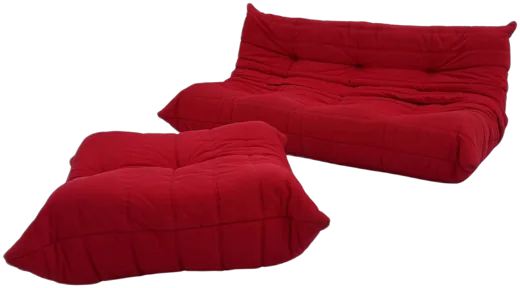
2. The Togo sofa — Michel Ducaroy, 1973

No frame, no legs: pleated foam "like a folded tube of toothpaste". Mocked when it appeared at the Salon des arts ménagers, the Togo went on to become Ligne Roset's absolute best-seller and the most sought-after vintage piece of its generation. See the original and its alternatives →
3. The Lounge Chair — Charles & Ray Eames, 1956

Three shells of moulded plywood, leather, an ottoman: the chair meant to have "the warm receptive look of a well-used first baseman's mitt". Seventy years on, it is still the most copied seat in the world. See the original and its alternatives →
4. The Panton Chair — Verner Panton, 1967

The world's first chair moulded from a single piece of plastic, fully cantilevered. It took ten years and four materials to get there; Vitra makes it still. See the original and its alternatives →
5. The Wishbone CH24 — Hans Wegner, 1950

A Y-shaped backrest, a seat of hand-woven paper cord — more than a hundred steps to make. In continuous production since 1950 at Carl Hansen & Søn, it is the Danish chair par excellence. See the original and its alternatives →
6. The Barcelona chair — Mies van der Rohe, 1929

Designed for the German pavilion at the Barcelona Exposition — and, so the story goes, so the King of Spain could sit on it. Two steel curves, forty buttoned cushions: the throne of modernism. See the original and its alternatives →
7. The Componibili — Anna Castelli Ferrieri, 1967

Endlessly stackable ABS cylinders, designed by the co-founder of Kartell. Bedside table, bathroom storage, studio trolley: the most versatile object on this list, and the cheapest in reissue. See the original and its alternatives →
8. The Ultrafragola mirror — Ettore Sottsass, 1970

A wave of opaline plastic that glows pink. Drawn in 1970, it became fifty years later the most photographed mirror on Instagram — to the point where Poltronova struggles to keep up with orders. See the original and its alternatives →
9. The Tam Tam stool — Henry Massonnet, 1968

Two plastic cones clipped together, moulded in twelve seconds. Twelve million sold, Brigitte Bardot photographed sitting on one: the democracy of design in a single object. See the original and its alternatives →
10. The Akari lamps — Isamu Noguchi, 1951

Washi paper from Gifu, bamboo, a bulb: "sculptures of light" that Noguchi wanted as weightless as leaves. The copies are everywhere; the real ones bear the sun and the moon as an ideogram. See the original and its alternatives →
And what if you spotted it in a photo?
Every piece on this list has its own reference page on Beyit, with the original, its story and alternatives at every price. And if a piece of furniture intrigues you in a photo — an Instagram interior, a film, a period house — scan it: Beyit identifies it.
One photo, every piece identified.
Your room, a shop window, an inspiration screenshot: send the photo, we find the pieces and their alternatives at every price.
On iPhone, the app does the same from your camera.
The pieces, at your budget.
Every piece mentioned, with its alternatives — from vintage to dupe.