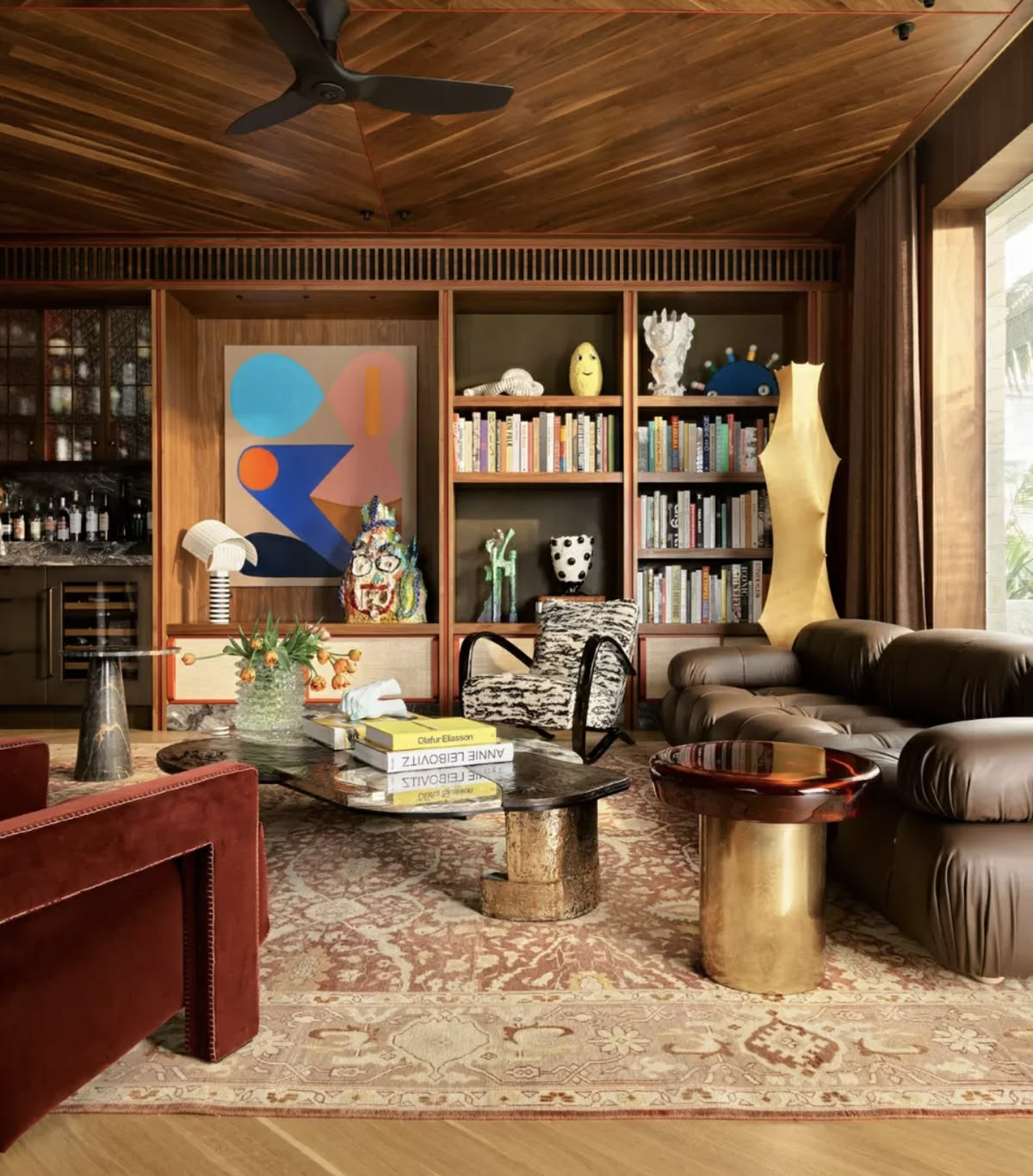
Decorating Styles Explained: How to Recognise Them, How to Mix Them
Mid-century, Scandinavian, japandi, industrial, Mediterranean, Memphis: the signs that identify each style — and the rules for mixing them.
3 MIN · 5 OBJECTS IDENTIFIEDStyle names are less about classifying than about choosing: to recognise a style is to know what belongs together — and therefore what can be mixed. Here are the six that shape today's interiors, each with its distinctive signs, its materials and its signature pieces.
Mid-century: compass legs and teak
Born between 1945 and 1965, from Danish workshops to Californian studios. Its signs: tapered or compass legs, teak and walnut, organic forms — the Noguchi table is its manifesto. The low sideboard is its reigning piece, the Eames DSW its chair. It is the most liquid style on the vintage market: everything can be found, everything can be resold. Its interiors are gathered on our mid-century page.
Scandinavian: light first
The Nordic cousin of the above, conceived for winters without sun: pale woods (oak, birch), off-white walls, wool and hides, soft lines. The Wegner Wishbone sums it up: visible craft, comfort without display. How to recognise it: nothing shines, everything is matt and tactile. Its interiors are on the Scandinavian page.
Japandi: the meeting
The contraction of Japan and Scandinavia says it all: the same woods, the same fibres, but lower lines, a more muted palette — beige, greige, brown — and emptiness as a material in its own right. It is the style that demands the fewest pieces of furniture and the most discipline: decluttering is structurally part of it. Its interiors are on the japandi page.
Industrial: the workshop owned
Black metal, raw wood, patinated leather, wired glass: the vocabulary of factories and workshops moved into the home. Its signs: exposed structures, castors, factory stools, charcoal grey as a backdrop. Its well-known drift: the total look that turns the living room into a show-flat loft set. It works better as an accent — a workshop lamp, a trade table — than rolled out wall to wall.
Mediterranean: earth and lime
Lime-washed walls, terracotta on the floor and in the tones, bleached woods, rattan and ceramics: the style that runs through Spain, Greece and southern Italy. How to recognise it: the colours seem sun-faded, the surfaces are irregular and the white is never cold. Its interiors are on the Mediterranean page.
Memphis: colour as manifesto
Milan, 1981: the group founded by Ettore Sottsass blows up good taste — printed laminates, primary forms stacked up, plain colours without hierarchy. Sottsass's Ultrafragola, which predates the group, announces its spirit; Mendini's Proust armchair, a cousin of Alchimia, shares the same pointillist insolence. Memphis is not lived as a total look: it is dosed, one piece per interior, like a punctuation mark. Its interiors are on the memphis page.
Mixing them without the room contradicting itself
The decorators' rule: a dominant style that sets the ground — the large furniture, the walls — and one or two accents from elsewhere. Natural bridges help: mid-century and Scandinavian share their woods and marry seamlessly; japandi and Mediterranean share fibres and renders; industrial warmed with leather joins mid-century. The free electrons — Memphis, seventies chrome, Art Deco — arrive as objects: a mirror, a lamp, an armchair.
The Beyit tip
A piece's style is read in its legs: tapered compass = mid-century, chromed tubular sledge = tubular Bauhaus, pale wood foot = Scandinavian, lacquered geometric base = Memphis. Faced with an unknown piece, look at the bottom before the top — it is the most reliable test on the vintage market.
An interior you like without being able to name it?
Scan the photo: Beyit identifies the furniture, reveals the references that compose the style, and offers each piece at every price point.
One photo, every piece identified.
Your room, a shop window, an inspiration screenshot: send the photo, we find the pieces and their alternatives at every price.
On iPhone, the app does the same from your camera.
The pieces, at your budget.
Every piece mentioned, with its alternatives — from vintage to dupe.


