The Grand Bouquet: Uchronia Grows a Flower in the Grand Palais Rotunda
Julien Sebban and his studio raise a monumental bloom beneath the Palais d'Antin rotunda, drawn from the floor mosaic and the arcade mouldings.
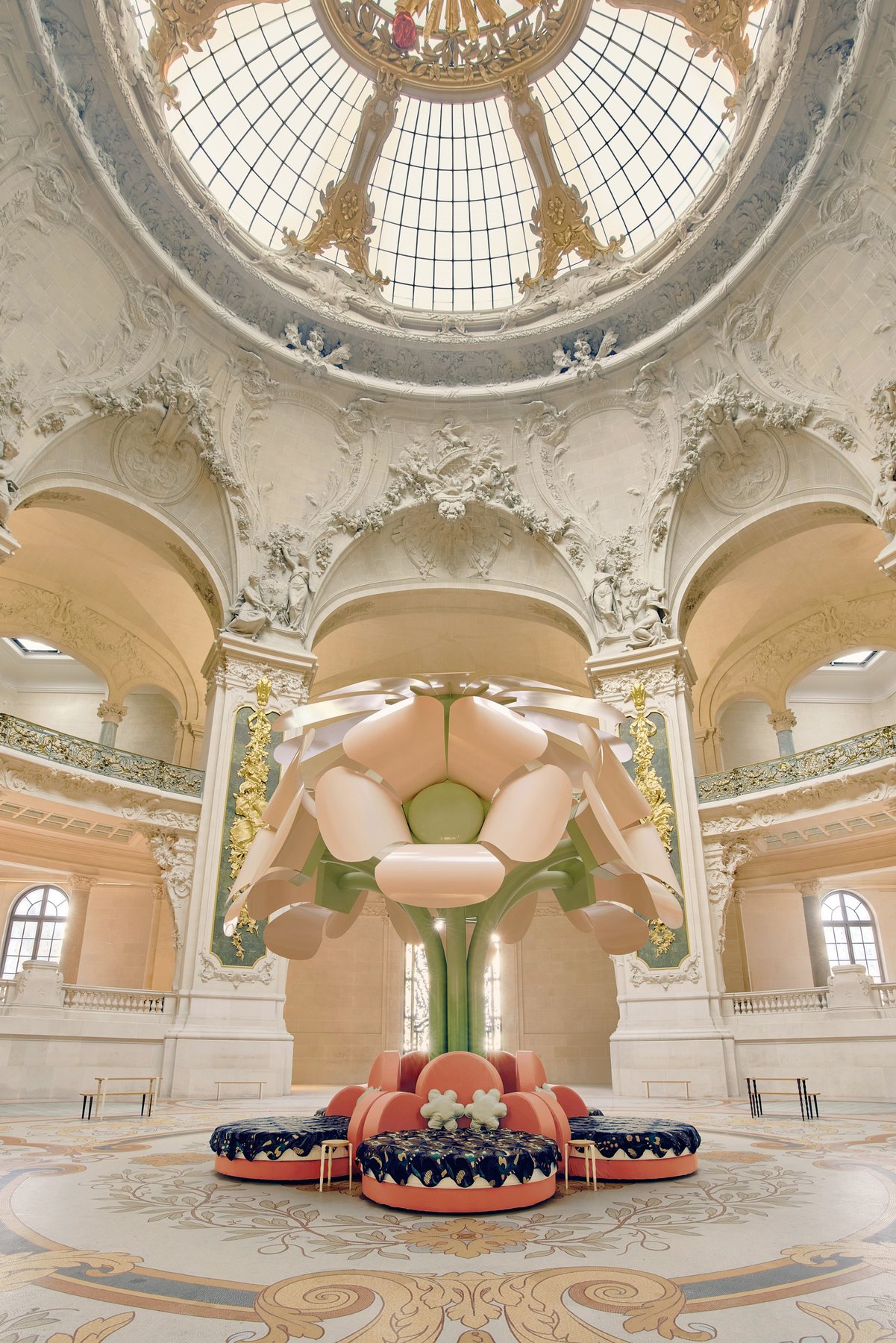
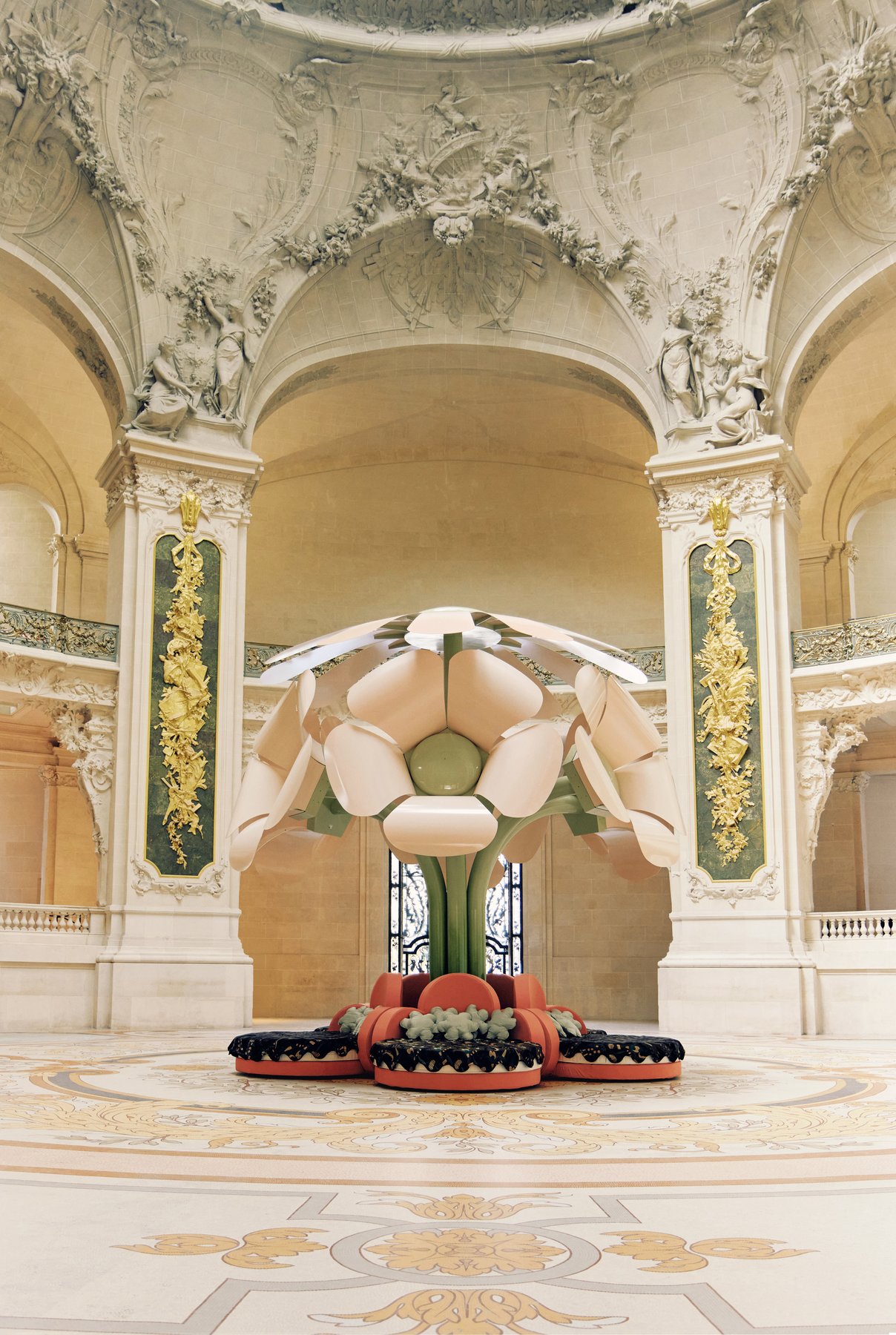
5 MIN · 12 September 2026The rotunda of the Palais d'Antin has a floral mosaic floor and arcades trimmed with plant-shaped mouldings. Nobody looks at them: people cross through. From 11 to 20 September, Uchronia plants Le Grand Bouquet here, a monumental bloom drawn from these two motifs — and the décor no one noticed becomes legible again because something immense has grown out of it.
A flower that comes from the floor
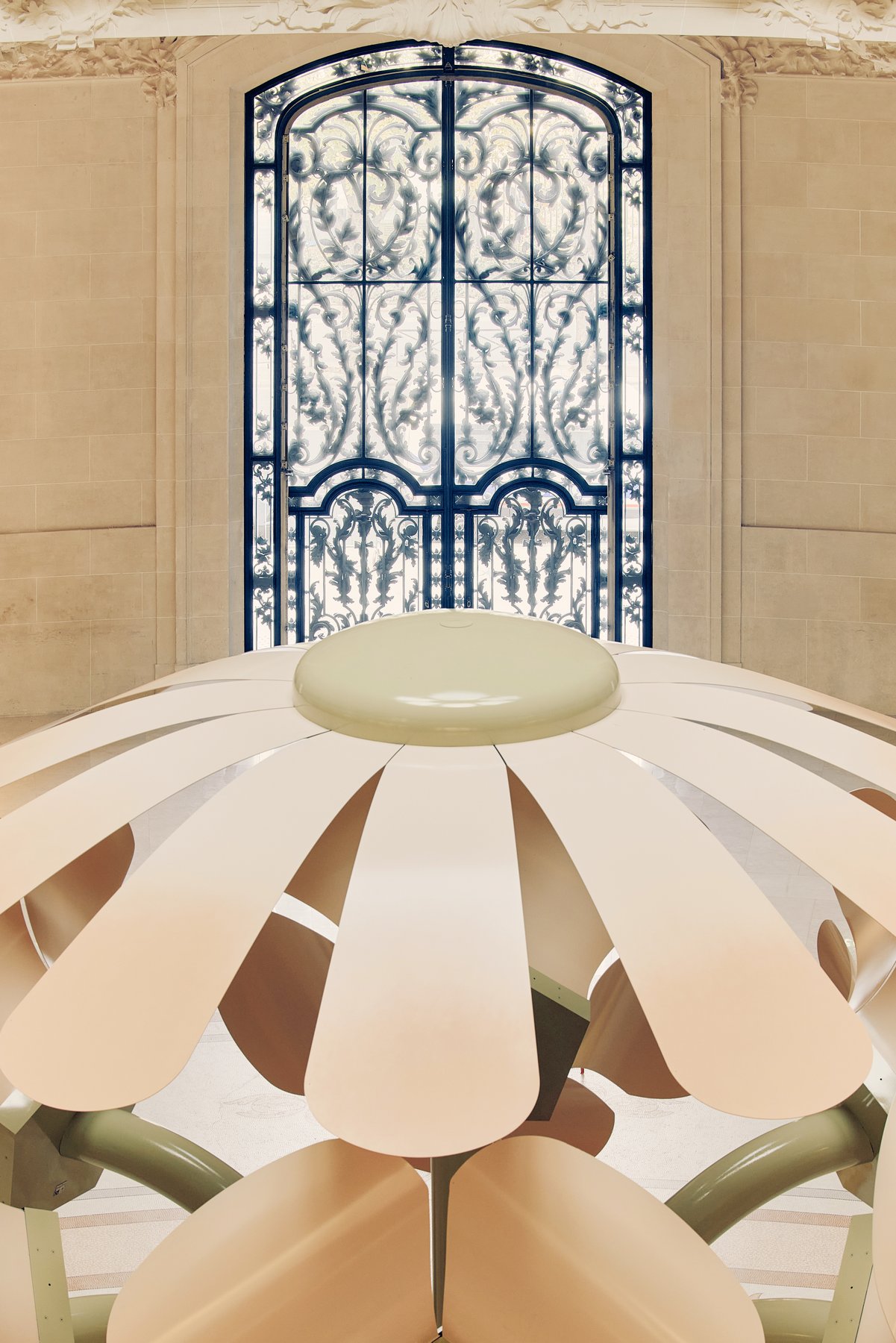
This is the most interesting thing about the installation, and the easiest to miss. The form of the Grand Bouquet is not dropped into the room: it is drawn from it. The petals, stylised and luminous, take up the drawing of the floor mosaic and the carved vegetation of the arcades; their arrangement follows the circular movement of the rotunda and leads the eye upward. The work behaves less like an object set down than like an extension of the architecture, an outgrowth of what was already there.
This kind of gesture has an immediate precedent in the same week: at the Musée Bourdelle, Anthony Guerrée takes up the sculptor's lines and transposes them into four materials. The difference lies in scale and register. Guerrée works in counterpoint, in a low voice, in museum rooms. Uchronia works out in the open, in a public volume crossed by thousands of people a day, and owns the demonstration.
The entrance is inflatable
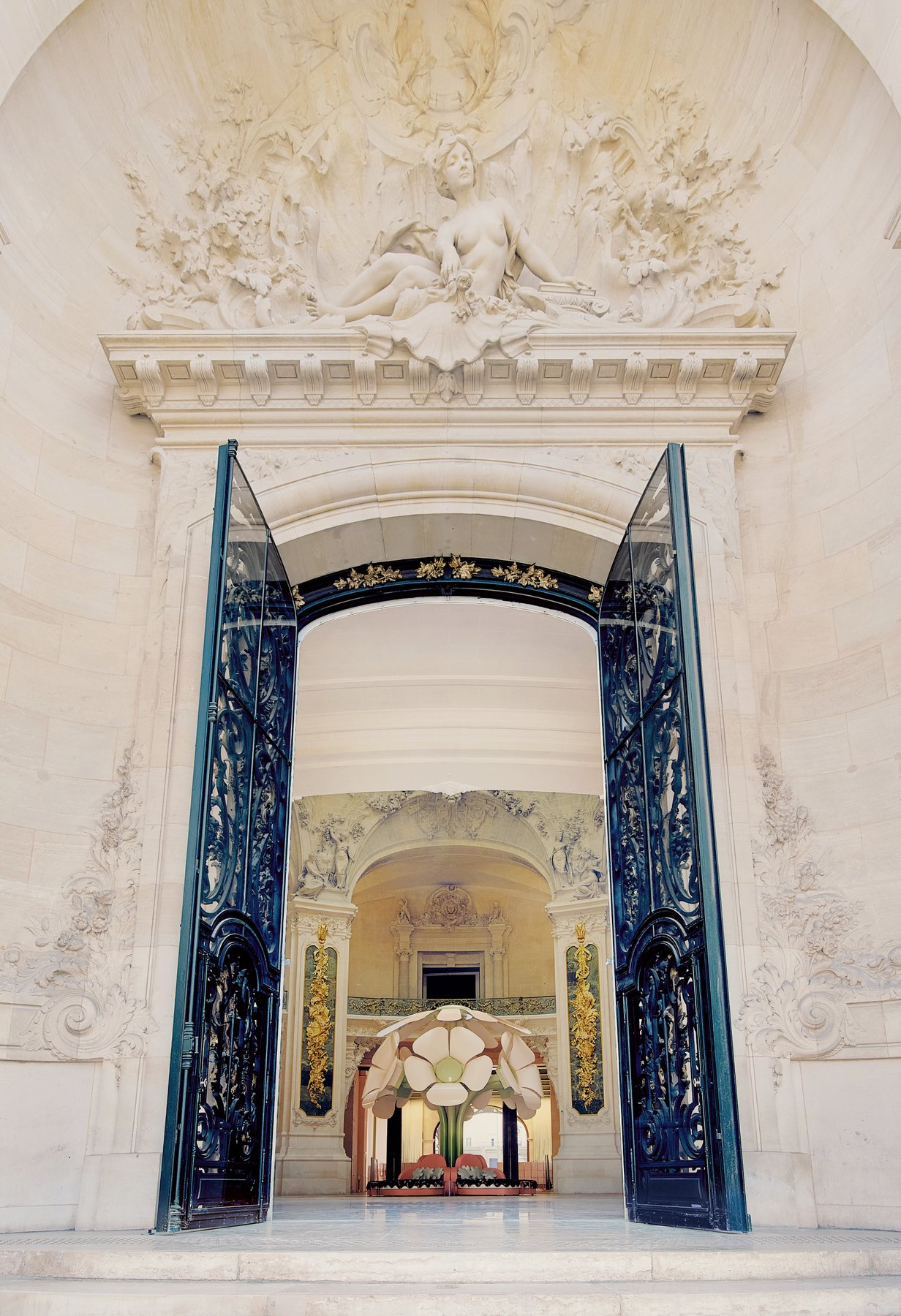
The experience begins before the building. On the forecourt, an inflatable structure welcomes visitors: a threshold to cross between the real and the imagined, at the foot of a classical façade. Setting generous, colourful forms in front of the rigour of the Grand Palais is a contrast easy to describe and hard to pull off; it is also, very concretely, the only part of the installation you can see without going in, and therefore the part that has to persuade passers-by to do so.
Joy, claimed as an argument
The studio makes no secret of it and puts it in black and white: the point is to celebrate joy as a force of resistance and of gathering. In a context marked by uncertainty, the installation asserts the power of beauty, imagination and optimism as ways of making connection. You may find the phrase broad. It has at least the merit of being a clear position in a trade where most exhibition texts avoid saying what they want.
Who is Uchronia
Julien Sebban founded Uchronia in Paris in 2019. The collective is multidisciplinary in the strict sense: architecture, interior design, scenography and collectible furniture, without these activities being split into departments. The name comes from uchronia, that fictional time in which history would have branched off — and the studio does indeed build immersive environments that look like places from another timeline.
To it we owe the renovation of the restaurant and bookshop of the Musée d'Art moderne de Paris, projects for Coachella, restaurants, boutiques, private homes, hotels. The vocabulary is constant: frank colour, expressive forms, avowed craft. In parallel, the studio has launched Univers Uchronia, a self-produced furniture collection made entirely in France — self-produced being the important word here: the studio publishes its own pieces, without going through a house.
What you can take home
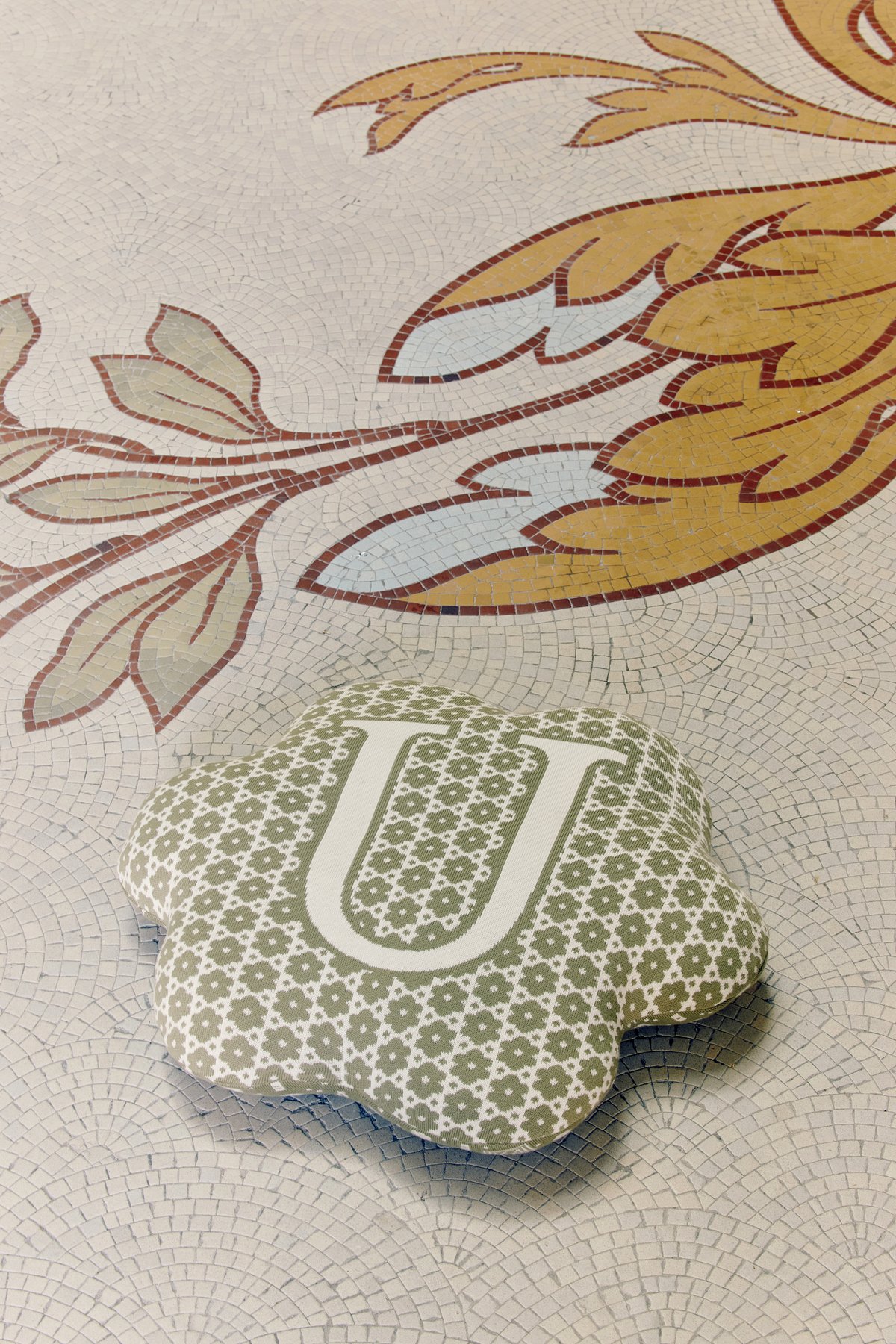
The Grand Palais's design and craft boutique presents a selection of objects drawn from the world of the Grand Bouquet, and this is the part of the operation that concerns us most directly: a monumental installation you can, for once, carry off in miniature. There are ceramic trays, dishes, plates and candlesticks born of a collaboration with Sol; Fleur cushions, Candy lamps, a fabric notebook, a keyring, the Bisou stool and the Flower table in-house; the Lou stool, the Pli shelf and a table leg with Tiptoe; and a Fall-Spring pad with Hercule Studio. All the creations are French-made.
The boutique itself is worth the detour independently of the installation. Its selection is curated around craft skills and exclusive editions, and it incorporates the moulding and chalcography workshops of the GrandPalaisRmn — centuries-old trades that still produce, within the building, pieces you will not find elsewhere.
What to look at as you enter
A reading tip, since the installation is built on a quotation: before you raise your eyes to the work, look at the floor. The rotunda's floral mosaic is the original document, and you only grasp the gesture once you have seen what it takes up. Then the arcades, whose plant-shaped mouldings supply the second register. These are two ornaments no one photographs and past which everyone walks; it is also what this kind of installation does best, when it succeeds — making visible a décor that had become invisible from sheer familiarity.
Eight metres high, six across
The figures, supplied by the Grand Palais press office: the flower measures 8 metres high and 6 metres across. It is the scale of a two-storey house set at the centre of the rotunda, and it is what makes the gesture legible from the entrance — you don't discover the Grand Bouquet, you come upon it.
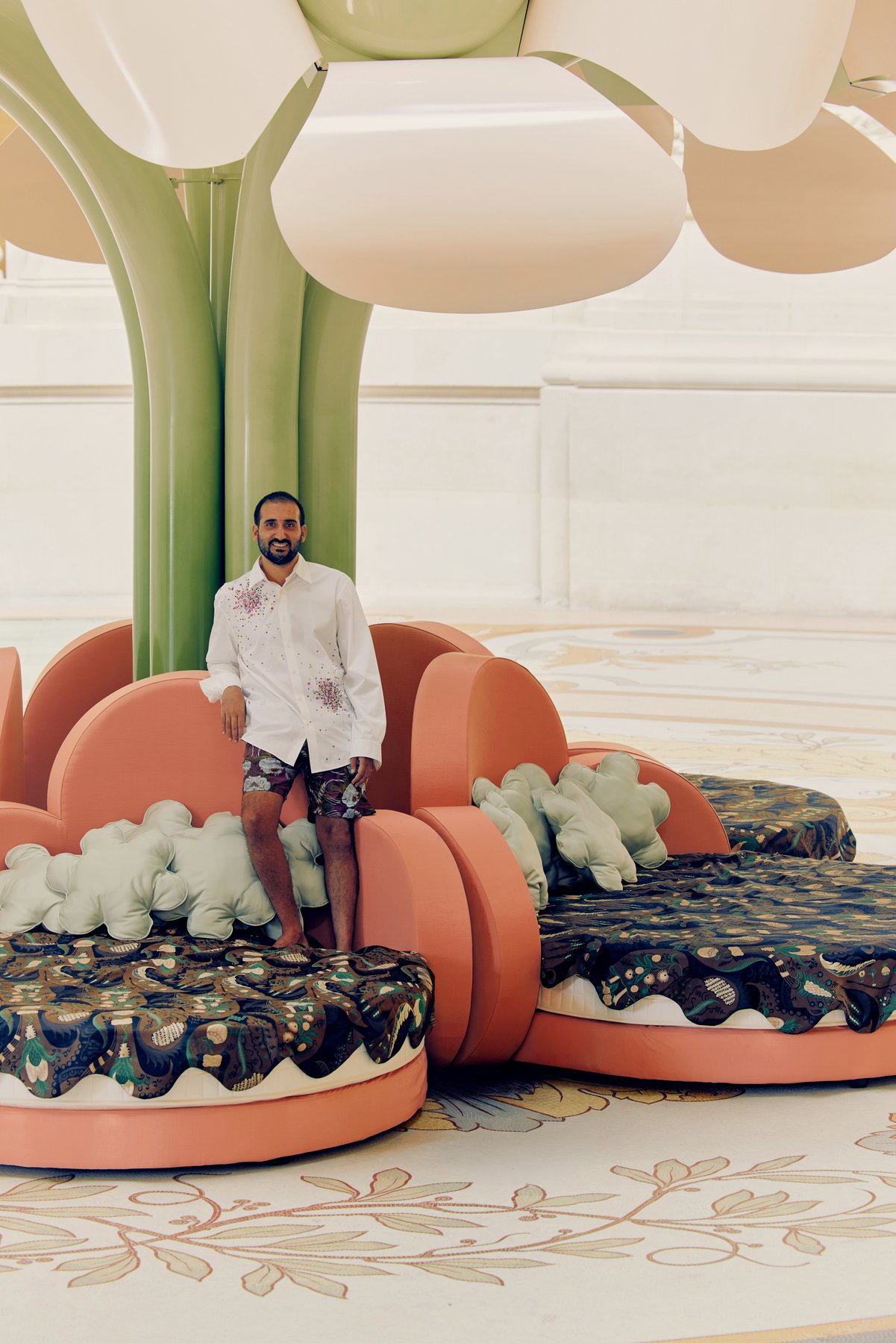
The structure that holds it is the work of the Atelier François Pouenat, an art ironworks that shapes iron, brass and copper by pairing old gestures with digital tools. The studio describes it as the backbone of the installation: it gives both the stability and the movement of the petals. The colour work is signed Chromatic and Seigneurie. At the foot of the flower, Tréca Paris has designed circular beds dressed in Prelle silks, woven in Lyon, to lie down and look at the work from below; Tiptoe sets seating along the route, and the tabletops are in Fenix surfaces. In other words: the installation is also a catalogue of French craft, and each of these houses can be visited or bought outside the Grand Palais.
The Grand Palais, reopened
It is worth recalling why this address matters this year. After four years of works, the building has reopened, and several of its spaces are freely and openly accessible, including the central Place and the Rotonde d'Antin. In other words: seeing the Grand Bouquet costs nothing and needs no ticket. During a week when many addresses run by invitation, that is a practical fact worth the trip on its own.
Going there
Le Grand Bouquet — Uchronia × Grand Palais, design and craft boutique and Rotonde du Palais d'Antin. Avenue du Général Eisenhower, square Jean Perrin, 75008 Paris. From 11 to 20 September 2026, Tuesday to Sunday, 9.30 a.m. to 8 p.m., late opening on Friday until 10.30 p.m. Free entry. Opening on Friday 11 September from 6 p.m., cocktail from 7 to 9 p.m. by invitation. Métro Champs-Élysées - Clemenceau (1 and 13) or Franklin D. Roosevelt (9).
The Beyit move: photograph a piece from the boutique and scan it — the tool tells you who publishes it, and whether it exists anywhere other than here.
One photo, every piece identified.
Your room, a shop window, an inspiration screenshot: send the photo, we find the pieces and their alternatives at every price.
Gallery
5 images