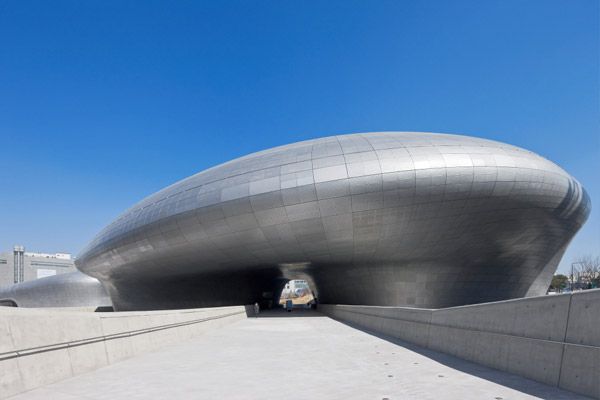

Zaha Hadid: The Curve That Bent Architecture
From drawings deemed unbuildable to wave-like buildings across the world. How Zaha Hadid imposed fluidity — and what she left to object design.
1 MIN · 15 August 2026For years, her drawings were judged “impossible to build”. Then Zaha Hadid (1950-2016) bent architecture to her will: buildings that flow, ripple, defy the straight line. The first woman to win the Pritzker, she changed the shape of the built world.
From utopia to reality
Trained among the deconstructivists, long an “architect on paper”, she waited for the 2000s and digital tools to build her visions: the Heydar Aliyev Centre (Baku), the MAXXI (Rome), the Bergisel ski jump. The parametric became her language.
Fluidity as a signature
No more angles, no more “flat” facades: space becomes continuous, liquid. A formal revolution that redefined what a building could be.
From building to object
Her grammar spread through design: furniture, lighting, vases with impossible curves (editions by Sawaya & Moroni, and others). A piece signed Zaha is an inhabitable sculpture.
Spotted a piece signed Zaha? Scan it on Beyit: the original and its alternatives.
One photo, every piece identified.
Your room, a shop window, an inspiration screenshot: send the photo, we find the pieces and their alternatives at every price.
On iPhone, the app does the same from your camera.
Gallery
4 images


