“I don't reproduce nature, I translate it.” The line could pass for press-kit elegance. With Emma Donnersberg, it describes a method: a mushroom, a cloud, a stone worn down by water are not motifs to be depicted, they are construction problems to be solved. Her gallery is on rue de Verneuil, in the 7th arrondissement.
Three trades, one body of work
Interior architect, collectible furniture designer, gallerist: most practitioners keep these activities separate, or turn them into successive careers. Donnersberg refuses the distinction and argues that each discipline continually revises the others. Trained in interior architecture in New York, she spent a decade on private residences, restaurants and hotels before turning, in 2017, to collectible furniture.
The shift produced a back-and-forth she describes precisely. Her interior projects gave her the spatial thinking that now underpins her furniture: how a room holds a body, how light runs across a surface, how a single object can set the tone of an entire space. Conversely, designing collectible pieces — where a form has to stand alone, with no walls to complete it — changed the way she conceives interiors. “I now work as much from intention and form as from function,” she says.
Nature as grammar, not as decor
This is what sets her work apart from organic aesthetics in general. Nature does not appear as an ornamental theme but as a body of formal principles — growth, asymmetry, movement, structural logic — that can be studied and applied the way an architect studies proportion. A mushroom cap becomes a question: where does the weight sit, why can an asymmetrical form feel more stable than a symmetrical one. The pieces that come out of it are sculptural first, decorative second.
She also makes a critical argument of it: contemporary life keeps people at a distance from the natural forms that shaped human perception for most of its history, and her pieces try to reintroduce that vocabulary into domestic space. Not as escape, she insists, but as a formal discipline legible to anyone who has ever watched a plant grow or a stone erode.
Four collections, a single enquiry
ORGANIKA, begun in 2017, is the starting point: the Mushroom side tables, in ceramic and bronze, isolate the object's essential logic — a cap, a stem, a point of balance — and treat it with the restraint of a study. The Cèpes stools, hand-turned in Portugal, push the same research towards abstraction.
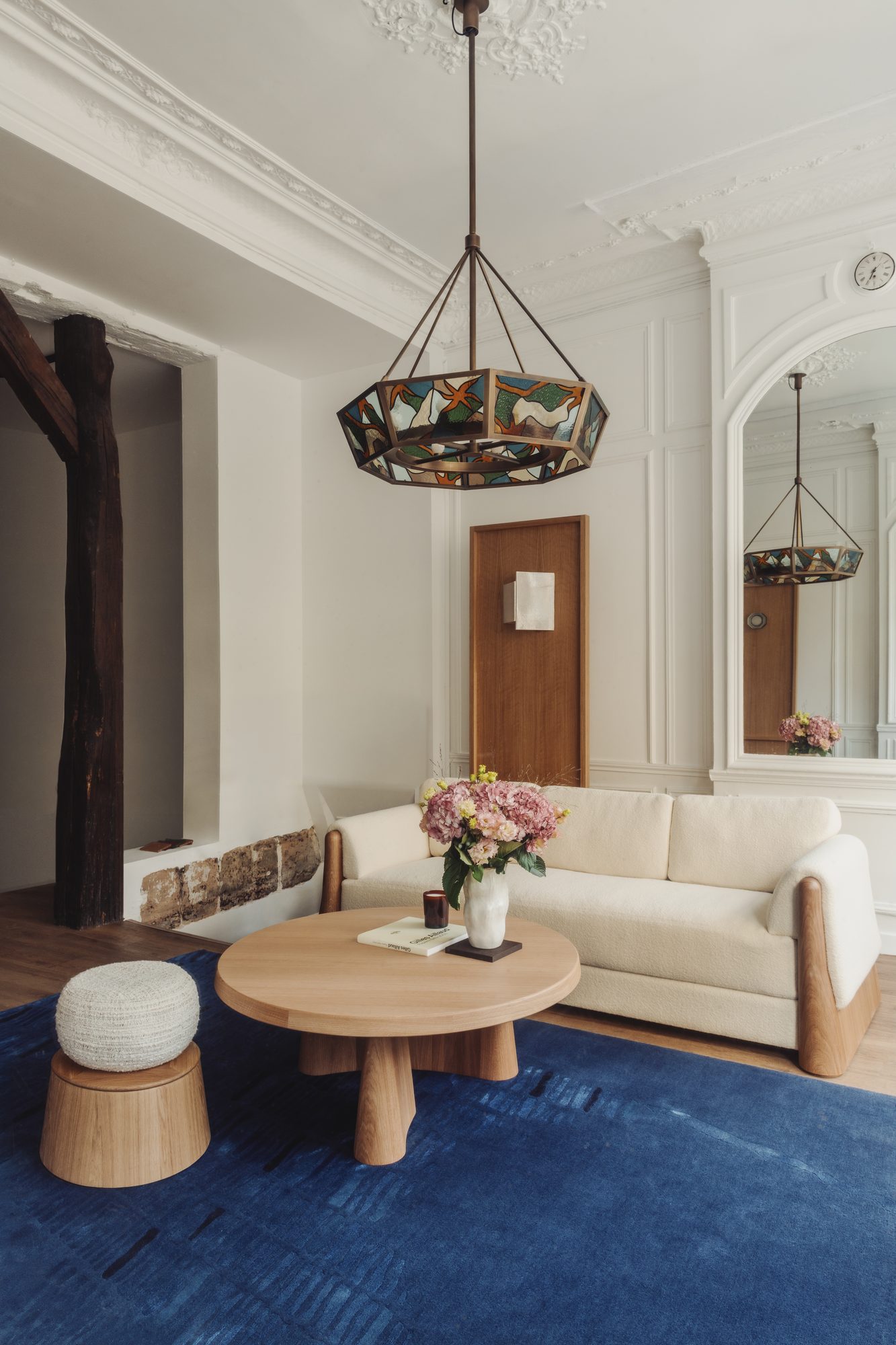
CLOUD, developed after her return to Paris in 2022, when she turned her own flat into a studio, extends the vocabulary of the isolated object into a full domestic register: seating, mirrors, wall lights, tables. The Wave sofa and the Cloud chairs translate the indeterminate edges of a cloud formation into upholstered volume; the Nuage mirrors and wall lights, in bronze and lacquered wood, carry the same softened geometry onto the room's fixed points. The Galet table, in oak or walnut and hand-cut stone, marks the move towards more architectural furniture, made to organise a room rather than to occupy a corner of it.
DELHI, unveiled in 2026, changes reference without changing method: where the first two collections started from organic form, this one turns to architecture and reinterprets the Red Fort, the India Gate and the Taj Mahal. The Arcus armchair, the Kerala mirror, the Marigold sofa, the Rainbow chairs and the Jaipur chaise longue keep the organic vocabulary and the hand finishes, but the question has moved: from the intelligence of natural growth to the place of the human in creation.
RIBBON, presented during 2026, changes register through material. After ceramic, bronze, stone and wood, the collection is conceived in stainless steel: bench, daybed, side table and console are born from a single continuous line that loops, folds back on itself and settles the way a ribbon would if left to find its own balance. The material is harder and more industrial than anything before it, the logic is unchanged: movement first, ornament second. The line does not decorate the object, it is the object.
“The craftsman carries half the responsibility”
This is the part of her method that matters most to anyone looking at furniture prices. Her pieces are developed with ceramicists, bronze founders, stonecutters and wood workshops in France, Italy and Portugal — among them the ceramicist Karen Swami, the sculptor Abel Cárcamo, the architect Michel Amar. Each material is chosen for a precise skill rather than for a generic finish: Italian marble and travertine, ceramic hand-turned in Portugal, French patinated bronze, sandblasted and bleached oak, onyx, lava stone.
The choice of workshop is inseparable from the drawing: a piece conceived for ceramic cannot simply be recast in bronze without becoming, in effect, another object. “Craft is a dialogue, not a production process,” she says. “The artisans I work with carry half the responsibility for the result.” Hence a consequence visible to the naked eye: irregularity is kept rather than corrected. A hand-turned base, a bronze that takes its patina unevenly, a vein of stone found rather than chosen — what would elsewhere be standardised becomes here the proof that the object was made by someone.
The gallery, and why it exists
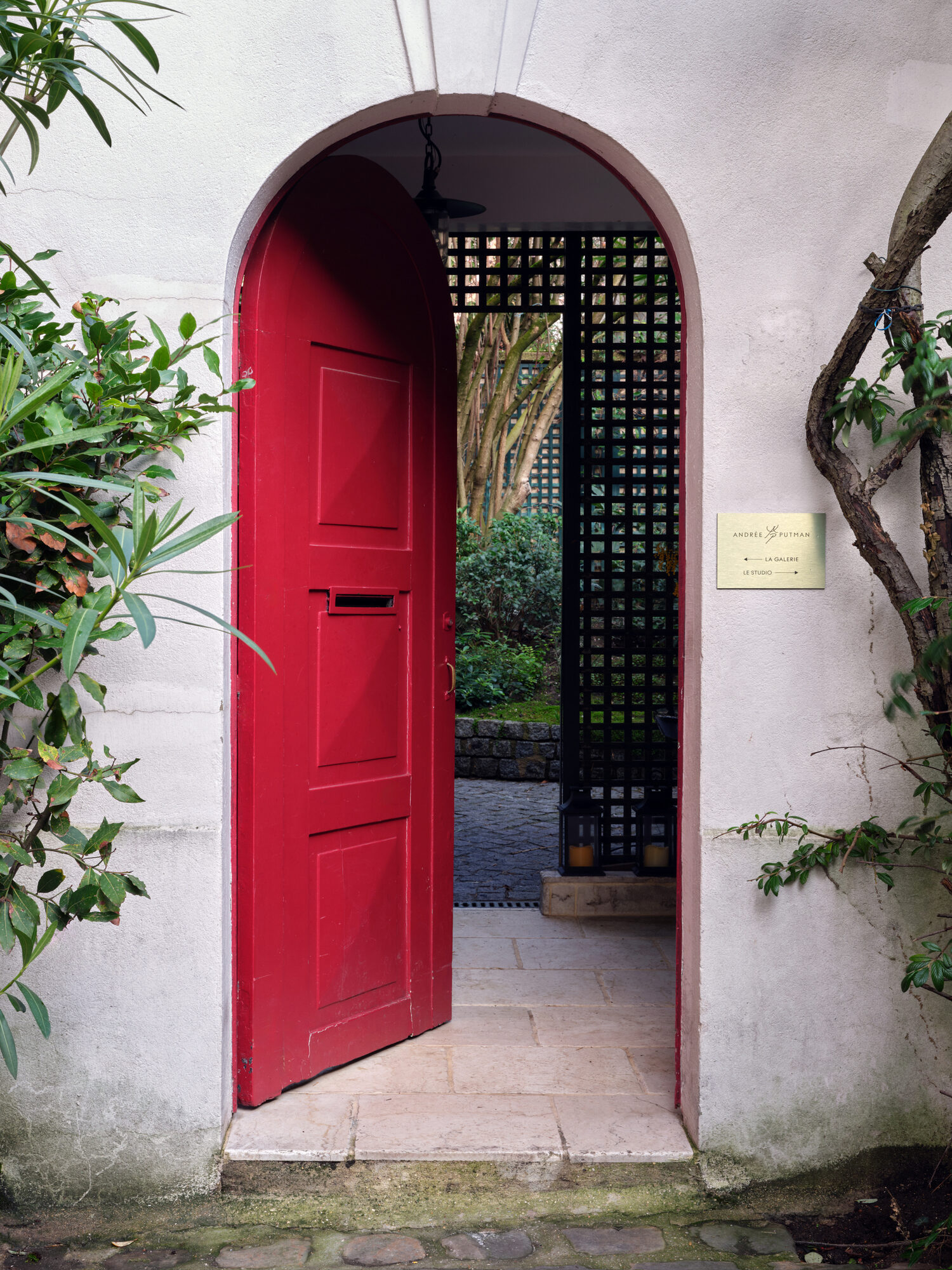
Donnersberg opened her gallery at 60 rue de Verneuil, in Saint-Germain-des-Prés, in October 2025. The decision followed several years of informal curating: with A date with art, a series of portraits filmed in the studios of women painters — among them ATSOUPÉ and Marcel·la Barceló — she was already testing in public the kind of dialogue the gallery now formalises.
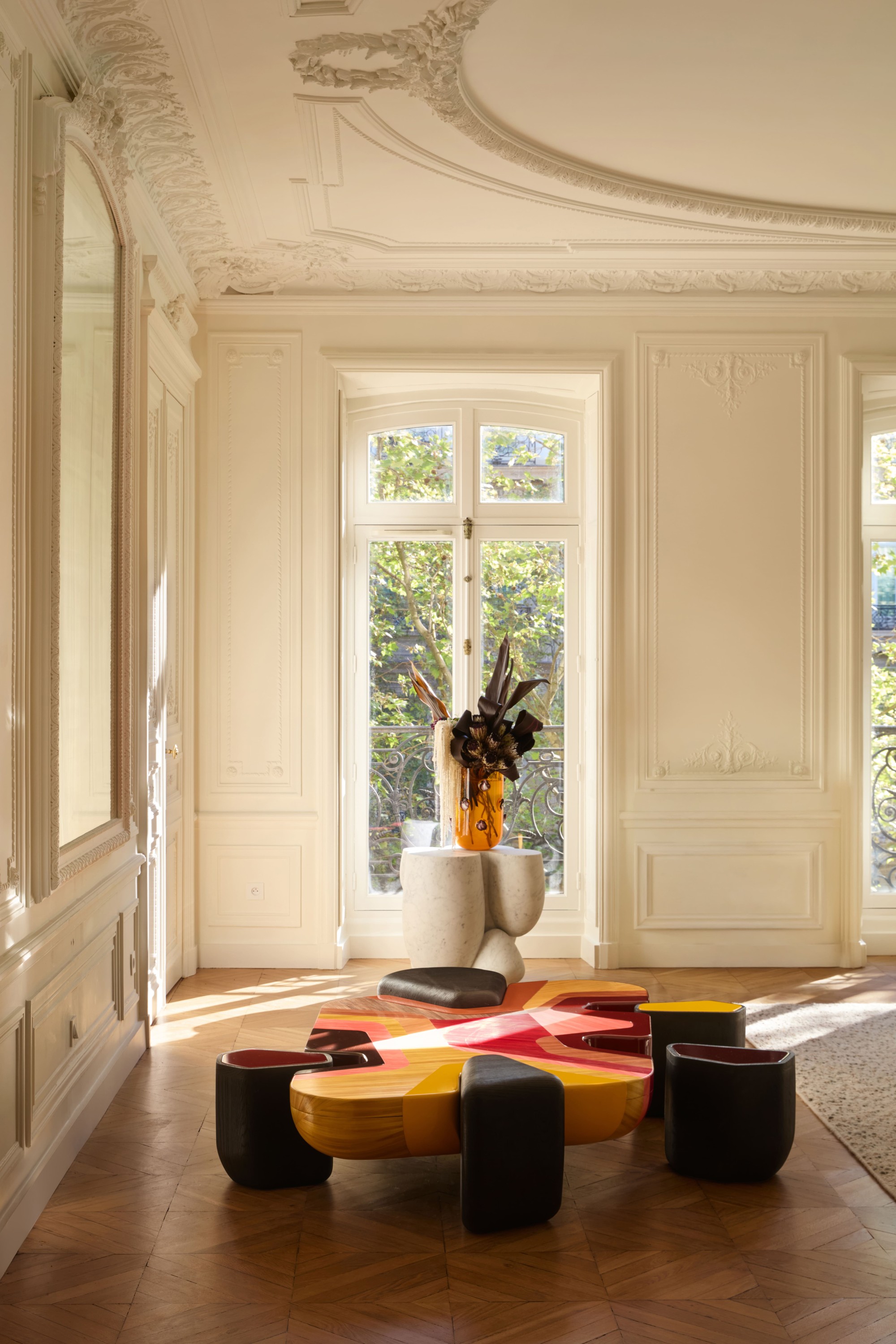
The principle is simple and rare: her own furniture is shown with the paintings on the walls, so that each exhibition works as a room where two disciplines have to share the space and sharpen each other by contrast. The most recent, The Mystic Hunt, presented Isabella Vella's paintings — foraged pigments, ink, gesso, medieval imagery and folklore — alongside pieces from the DELHI and RIBBON collections.
What the gallery shows
The gallery presents the RIBBON and DELHI collections, the looping steel and the Indian architecture, her two most recent, alongside signature pieces from the permanent collection. In a single room you can see how far the work has travelled since the mushrooms of ORGANIKA.
Coming next
In January, Emma Donnersberg will present two new chairs. She had also announced, for Design Miami Paris in October, a series of ceramic mushroom sculptures, each one unique: a return, ten years on, to the object that launched her practice, fed by her travels in Africa.
Going there
Galerie Emma Donnersberg, 60 rue de Verneuil, 75007 Paris. Monday to Friday, 10 am to 6 pm, closed at weekends. The gallery opened in October 2025 and shows the house's furniture alongside the paintings on display.
The Beyit move: photograph a piece, scan it. The tool tells you whether it is in production, and what exists in a single example only.